
Custom AI certification cost: what actually drives it (and when not to build one)
No published pricing exists because it depends on tool novelty, SME time, and cohort size. Here's what drives cost, and when a published track wins instead.
September 18, 2026 · 7 min read

We don't publish a price for custom AI certification tracks, and that's not a sales tactic — it's because the honest answer varies by an order of magnitude depending on three things: how novel the tool is, how much of your engineering leads' time the rubric needs, and how big the first cohort is. Anyone who quotes you a flat number before a scoping call is guessing. What we can tell you honestly is what actually drives the cost and time, and how to work out for yourself whether you need a custom track at all — because for a lot of companies asking this question, you don't.
What actually drives cost and time in a custom build
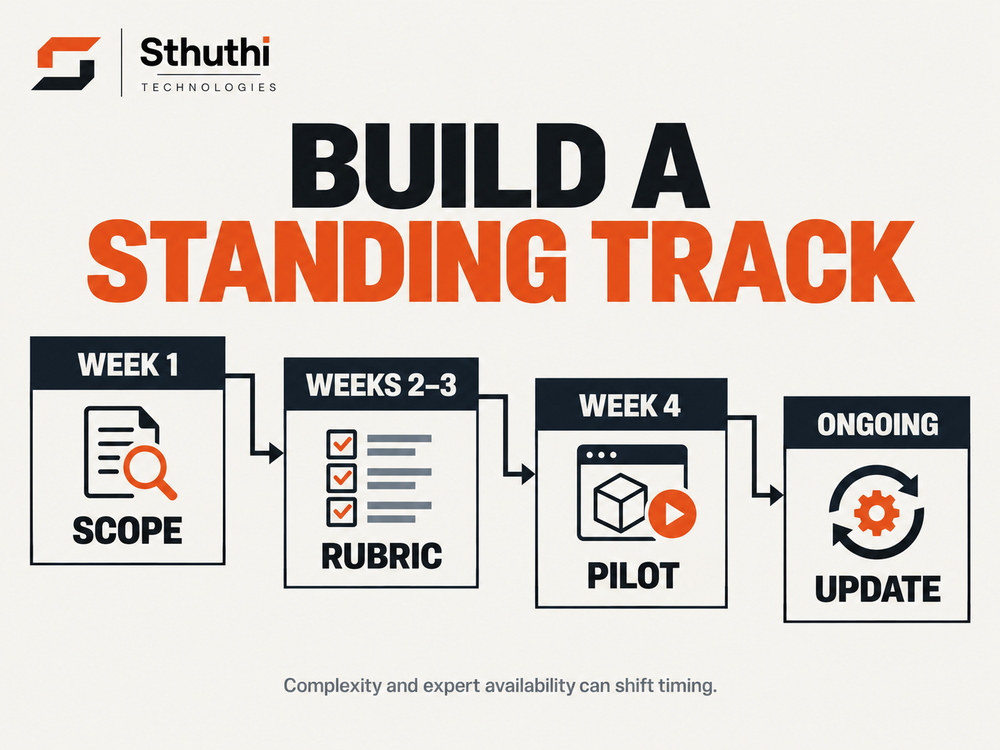
Our own process runs on a four-stage timeline: a Week 1 scoping call with an engineering lead to draft the task list, Week 2–3 spent writing the rubric and pilot curriculum for your team to review and edit, a Week 4 pilot cohort that runs the full assessment and surfaces what needs adjusting, and then an ongoing standing track that gets revisited whenever the underlying tool changes meaningfully. That structure is fixed. What moves inside it — sometimes by weeks, sometimes by months — is driven by a small number of variables:
- How novel or proprietary the tool is. Certifying engineers on an internal LangGraph-based agent framework means building the task list from scratch, because there's no public documentation or existing best-practice writing to draw on. A proprietary Copilot fork running in an air-gapped environment adds another layer: nothing about the assessment can touch the public internet, which changes how the pilot has to be proctored.
- How much subject-matter-expert time the rubric needs. The Week 2–3 rubric sign-off is only as fast as your engineering leads' calendars allow. A legal team's document-review prompt-engineering rubric, for example, needs someone who understands both the workflow and its failure modes to sit with us and argue about edge cases — that's real hours from someone whose time is expensive and already spoken for.
- Pilot cohort size. A five-person pilot in Week 4 surfaces problems with the rubric quickly and cheaply. A fifty-person pilot takes longer to schedule, needs more proctoring capacity, and generates more edge cases to fold back into the rubric before the track goes standing.
- Curriculum complexity and interactivity depth. This one has industry data behind it, even though it comes from general corporate e-learning rather than certification specifically: a widely-cited Chapman Alliance analysis, reported by ATD, found that basic e-learning takes roughly 79 hours of production time per finished hour, while advanced work involving simulations and branching scenarios can run as high as 716 hours per finished hour. A proctored, in-repository assessment isn't e-learning, but the same shape of relationship holds: a rubric that has to judge live judgment calls against a real tool takes meaningfully longer to build than a rubric that checks recall of static material.
Basic e-learning: ~79 hours of development per finished hour. Advanced simulations: up to ~716 hours per finished hour.Chapman Alliance research, via ATD (td.org)
None of this is Sthuthi-specific inflation — it's the same reason any vendor building something bespoke around your internal tooling needs a real conversation before naming a number. The variables above are also, not coincidentally, exactly what a good scoping call is designed to pin down in the first week rather than the fourth.
Published track vs. custom: a decision framework
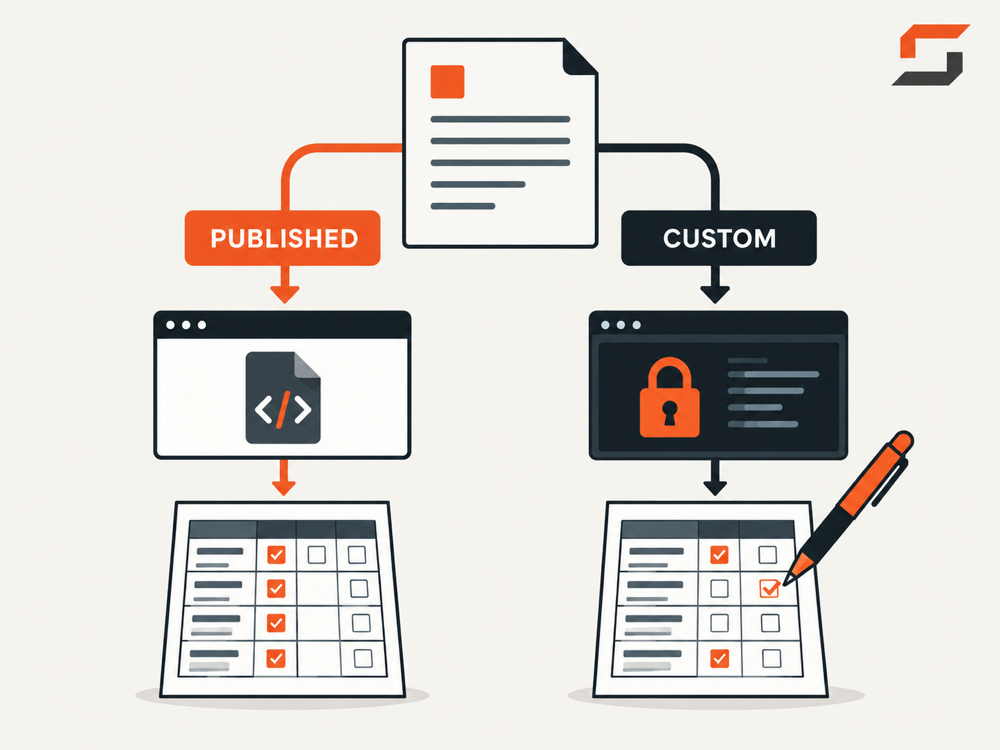
Before you start a scoping call, it's worth running your situation through a short checklist. None of this is unique to certification — it's the same build-vs-buy logic L&D teams have used for years on training content generally, adapted to what a credential actually needs to prove.
- Is the tool covered by a track that's actually open to you? Check whether a published track already exists for the mainstream tool you're using — Claude Code, Codex, GitHub Copilot, Gemini, Cursor — and whether it's open to any company or gated behind a partner network you're not in. A gated program isn't really an option; an open one usually beats building your own.
- Does public best-practice material exist for this workflow? If engineers elsewhere have written about how to use the tool well, a published or lightly-adapted track can draw on that. If the workflow only exists inside your company, there's nothing for a published track to be built on top of.
- Is the thing you're certifying an internal tool or a company-specific process? An internal agent framework, a fork of a vendor tool, or a workflow rubric scoped to one team's domain (legal document review, a specific compliance process) has no vendor certification to buy — custom is the only option that actually tests it.
- Does the environment have hard constraints a vendor exam can't accommodate? Air-gapped networks, no data leaving the building, or tooling that can't be described to a third party in detail rule out most off-the-shelf options by default.
- Is this a one-time check or a standing pipeline? If you need to certify five people once, the fixed cost of a custom rubric is hard to justify next to a published track's per-seat cost. If you're certifying every new hire on the same internal tool indefinitely, a standing custom track amortizes that fixed cost over years of cohorts instead.
If your honest answers land mostly on the first two points, a published track is very likely the faster, cheaper, and equally rigorous choice — building a custom rubric to test the same thing an existing proctored exam already covers is wasted scoping time, not thoroughness. Custom only earns its cost once the tool itself, not just your preference for control, is what's forcing the issue.
What to bring to a scoping call to make it efficient

The biggest lever you have over how long Weeks 1–3 take isn't anything we do — it's how much of the groundwork is already sitting in your own docs before the call happens. Bring:
- A rough list, even an informal one, of the tasks someone certified on this tool should be able to do. It doesn't need to be a finished rubric — that's Week 2–3's job — but a blank page costs more time than an imperfect draft.
- A named engineering lead who can actually hold time across the scoping call and the rubric sign-off, not just attend the first meeting. The rubric review in Week 2–3 is where most of the real back-and-forth happens.
- Any existing internal documentation, wikis, or onboarding material for the tool. Every page that already exists is a page we don't have to reconstruct from an interview.
- A realistic pilot cohort size and who's in it. "Whoever's available" produces a slower, messier pilot than five named engineers who've agreed to the Week 4 slot in advance.
- Any hard constraints up front — air-gapped environment, no external network access, data that can't leave the building. These change how the assessment has to be proctored, and they're much cheaper to design around from the start than to retrofit after Week 2.
If you've worked through the checklist above and landed on custom, the next step is the fuller custom-certification page for the details of how we run that process, or start a scoping call directly. If you landed on a published track instead, the full list of tracks covers Claude Code, Codex, GitHub Copilot, Gemini, and Cursor — and either way, if you're still not sure which side of the line you're on, ask us before committing to either. For a side-by-side view of published routes, see what Claude Code certification costs in 2026.
Want your team's AI-tool usage actually checked?
See the published certification tracks, or tell us about the tool you're worried about.