





Claude Code · For engineering teams
Claude Code

Prove your engineers can run Claude Code on real repositories.

Cohort training that ends in a proctored, human-reviewed task in a live repository. An independent credential with a verifiable ID, open to any company with no partner status needed.

Independent credential · Not issued by Anthropic

All certification tracks
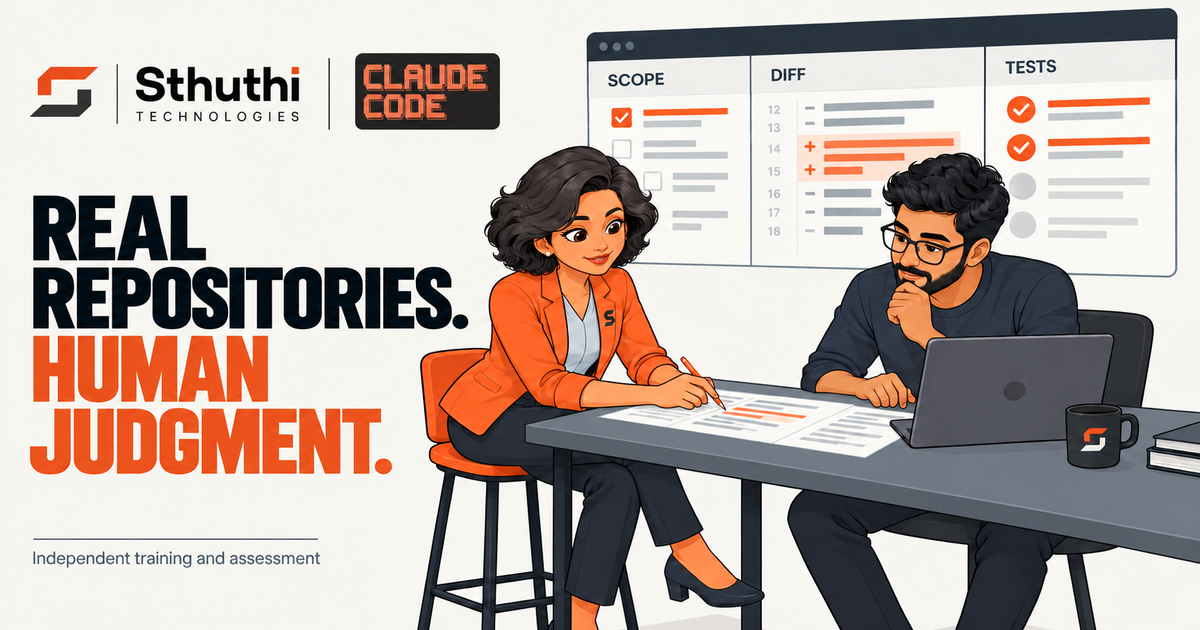
Sthuthi guide reviewing Claude Code repository changes with an engineer before human assessment.
Engineering-team cohorts focus on directing and checking work in real repositories.

405

employees certified on Claude Code across 4 organisations, including one client that came back for a second batch. See the clients or read the case studies.

ShelVey AIAmro Agentic AIKenect AIThe Payzon

Which Claude Code credential do you actually need?

Four real options. They answer different questions, so pick by the question you're asking.

Anthropic's free courses

  • Claude Code 101, Claude Code in Action
  • Self-paced, no proctor
  • Ends in a completion badge

Good first step

Course certificates

  • Coursera (Vanderbilt), Udemy and similar
  • Graded assignments or quizzes, no proctor
  • Shows a course was finished

Proves completion, not skill

Anthropic's CCDV-F exam

  • Official, proctored, $125
  • Booked through the Claude Partner Network
  • Covers API, Agent SDK and MCP, not only Claude Code

Counts toward Anthropic partner tiers

Sthuthi Claude Code track

  • Independent, proctored, human-reviewed
  • Live task in your engineers' own workflow
  • Open to any company, no partner status needed

Not issued by Anthropic

Want the full picture? See Sthuthi vs Anthropic's certification, assessed certification vs workshops, or all Claude Code certification alternatives.

Why Payzon booked a second cohort.

The Payzon

The Payzon

227 employees certified · Two cohorts

Cohort 1 · 125 employees
14 March – 8 April 2026
Cohort 2 · 102 employees
12 May – 6 June 2026

Claude Code Certified Practitioner
Independent credential issued by Sthuthi Technologies.

Read the The Payzon case study

“Partnering with Sthuthi Tech to certify our engineering organization on Claude Code transformed our delivery pipeline faster than any tool rollout we’ve attempted before. The structured hands-on approach didn't just teach syntax—it reshaped how our teams architect, refactor, and review payment microservices daily. We saw immediate uplift in developer velocity and code quality right out of Batch 1, which made expanding the certification to our remaining core teams an easy decision.”

Marcus VanceVice President of Engineering, Payzon

Payzon reported a 35% reduction in code review turnaround time and increased test coverage within 30 days of its first cohort. These results were reported to us by The Payzon, which authorised their publication. Sthuthi did not run the measurement, and results depend on each team's starting point.
Rolling out the tool was the easy part.

The harder question is whether the people using it can be trusted with your repositories.

A licence is not a skill

Seat counts and prompt volumes show who opened the tool. They don't show who would catch a diff that quietly widens scope or pulls in a new dependency.

More code is not more shipped

Google's 2025 DORA research links AI adoption to higher delivery throughput but lower stability. The gain depends on review, testing and rollback discipline.

Read the evidence

Anthropic's exam isn't open to most teams

Anthropic's own certification is booked through its partner programme and covers the wider Claude platform, not a repository-level check of your engineers.

What actually exists

Claude Code training for teams that ends in a real test.

The training runs as a cohort. Live, instructor-led blocks of 90 minutes, in small groups, so the instructor is looking at your engineers' real code rather than reading slides. Async modules cover the parts that don't need a room, such as settings, permissions and the review checklist.

Every cohort ends in the same place: a proctored task in a live repository, reviewed by a human assessor. That's the difference from a workshop. You finish with evidence of what each engineer can do, not just attendance. If you're planning a wider rollout, our 90-day Claude Code rollout playbook shows where the cohort fits.

Claude Code corporate training: 2 to 4 week cohorts on live code.

Duration
Typically 2 to 4 weeks per cohort
Format
90-minute live blocks plus async modules
Group size
Small instructor-led groups
Delivery
Remote by default; on-site on request
Scheduling
Around your team's working hours
Material
Your own repositories and workflows

What the assessment checks.

Judgment calls, not a quiz about the tool. Each engineer works in a real repository while an assessor watches how they scope, review and control the agent. See the Claude Code best practices we check. Want to practise first? Use our Claude Code review checklist.

Three levels

  • Foundations. New hires and engineers being onboarded onto an AI-enabled codebase.
  • Practitioner. Engineers who will run Claude Code against production repositories, and tech leads reviewing AI-authored diffs.
  • Expert. Senior engineers and platform teams standardising how the tool is used across a codebase.
    01

    Task framing

    Writing a scope Claude Code can execute without babysitting, and recognising when a task is too ambiguous to hand off.

    02

    Diff review

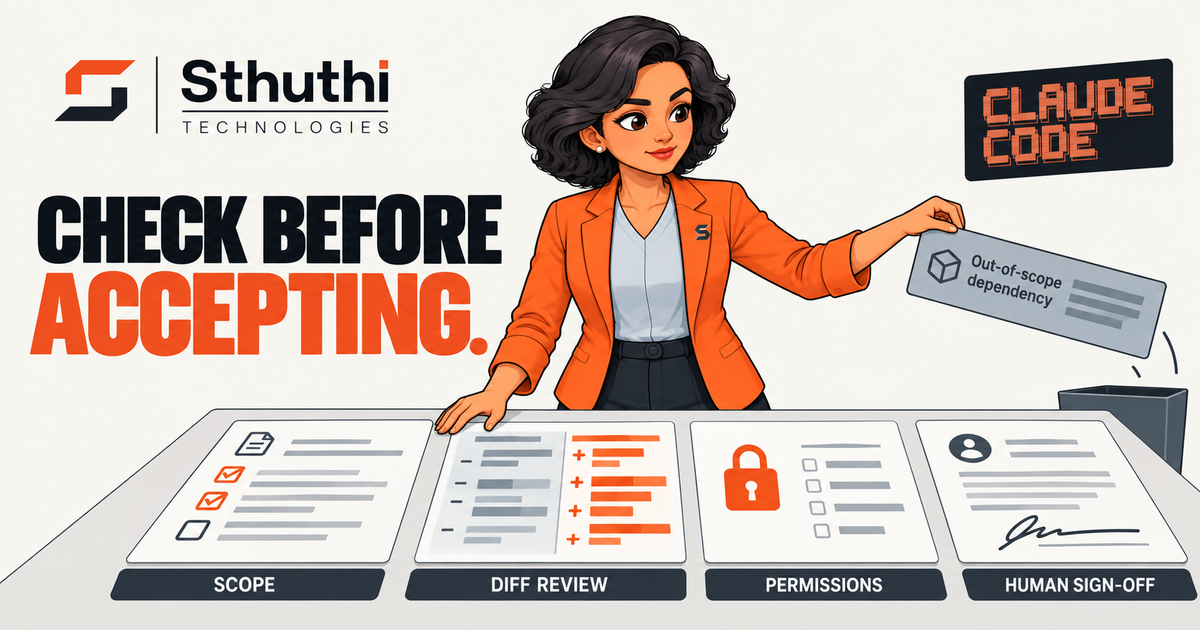
    Reading an agent-authored diff for correctness, scope creep and quietly introduced dependencies.

    03

    Guardrails and permissions

    Setting what the agent can touch, including file scope, command execution and network access, before it runs unattended.

    04

    A live repository task

    The engineer directs Claude Code to ship a scoped change, then walks a human assessor through their review before it merges.

Claude Code team assessment showing scoped tasks, diff review, permissions and human sign-off.
The assessment checks scope, changes and permissions before a human assessor signs off.

Certifying a whole team? Start with a 10 to 20 engineer pilot.

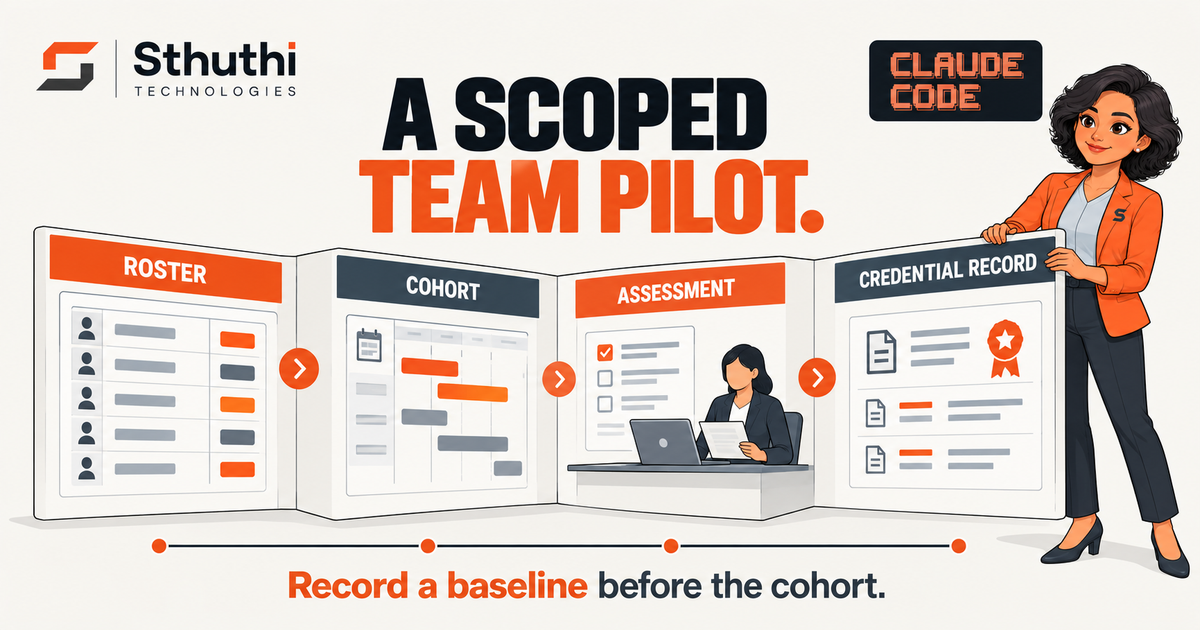
Start with a pilot, not a company-wide commitment. Record a baseline first so you can see what changed, then expand by repository or role once the numbers are in. The Claude Code rollout plan covers the full 90 days. Here's how we'd measure it.

  1. 01

    Before: pick the pilot and record a baseline

    Choose 10 to 20 engineers who already work in live repositories, map each to a level, and record review time, rework and cycle time first.

  2. 02

    Cohort: 2 to 4 weeks on real code

    Instructor-led sessions on your engineers' own workflow, plus async modules for the parts that don't need a room.

  3. 03

    Assessment: proctored and human-reviewed

    A task-based assessment inside Claude Code. An assessor reviews every attempt, pass or fail, and each pass gets a credential with a unique ID.

  4. 04

    After: compare and decide

    Compare against the baseline, then decide whether to expand by repository or role. Payzon booked a second cohort this way.

Sthuthi guide scoping a Claude Code pilot through roster, cohort, assessment and credential records.
Scope the roster, run the cohort, assess the work and record each credential.
Get a quote for your team

The credential

A credential ID someone else can check.

Every certificate carries a unique ID in the format ST-TOOL-YEAR-SEQ, and the assessor who reviewed the attempt signs off on the record. A client or hiring manager can ask us to verify it.

Example ID: ST-CC-2026-00417

Verify a credential

Training students, not employees?

There's a separate Foundations programme for colleges and universities. In India? See our page for IT services companies.

See the student programme

Frequently asked questions

Is this an official Anthropic certification?

No. It is Sthuthi Technologies' independent, proctored assessment, and Anthropic does not issue or endorse it. Describe it as "certified through Sthuthi Technologies' Claude Code programme", not "Anthropic certified".

Does it count toward Anthropic's Claude Partner Network tiers?

No. Only Anthropic's own certifications count toward partner tiers. If your goal is partner status, take Anthropic's exams; if your goal is to verify what your own engineers can do in a repository, this track is built for that.

Will it make our engineers faster?

We don't promise that. Research on AI coding tools is mixed, with some strong gains and some slowdowns for experienced developers. We recommend recording a baseline before the cohort, such as review time, rework and cycle time, and comparing after. Our guide for CTOs shows how.

What does it cost?

We quote per cohort, based on roster size and the levels involved, and give you a number on the scoping call. There's no obligation to go further after that call.

Can new hires and senior engineers go through the same track?

Yes. The track is levelled Foundations, Practitioner and Expert, so a new hire and a five-year engineer aren't assessed against the same bar.

How long does corporate Claude Code training take?

A cohort typically runs 2 to 4 weeks. Our client cohorts so far have run from 12 days to about 4 weeks, depending on group size and level.

Is the training remote or on-site?

Remote by default, in small instructor-led groups scheduled around your team's working hours. On-site delivery is available if you want the assessment proctored in person.

Can the training use our own repositories?

Yes. Sessions and the assessment task are scoped around the repositories and workflows your engineers actually use, agreed with your tech leads before the cohort starts.

Do we need Anthropic partner status to certify our team?

No. Anthropic's own exams are booked through the Claude Partner Network. This track is independent and open to any company.

How do we verify a credential?

Every certificate carries a unique credential ID, a verification code and a QR code. Scan the QR code or enter both values at sthuthi-tech.com/verify to see the holder, the credential and whether it is still valid.

Find out what your team can do in a repository.

Tell us how many engineers and which repositories. We'll scope a pilot and quote it on one call.