
Should companies certify their Claude Code teams in 2026-27?
Yes, as a measured pilot, not a promise of faster releases or protected jobs. What an independent Claude Code assessment checks, what the productivity and layoff evidence really says, and how to budget it.
October 5, 2026 · 19 min read
The short answer
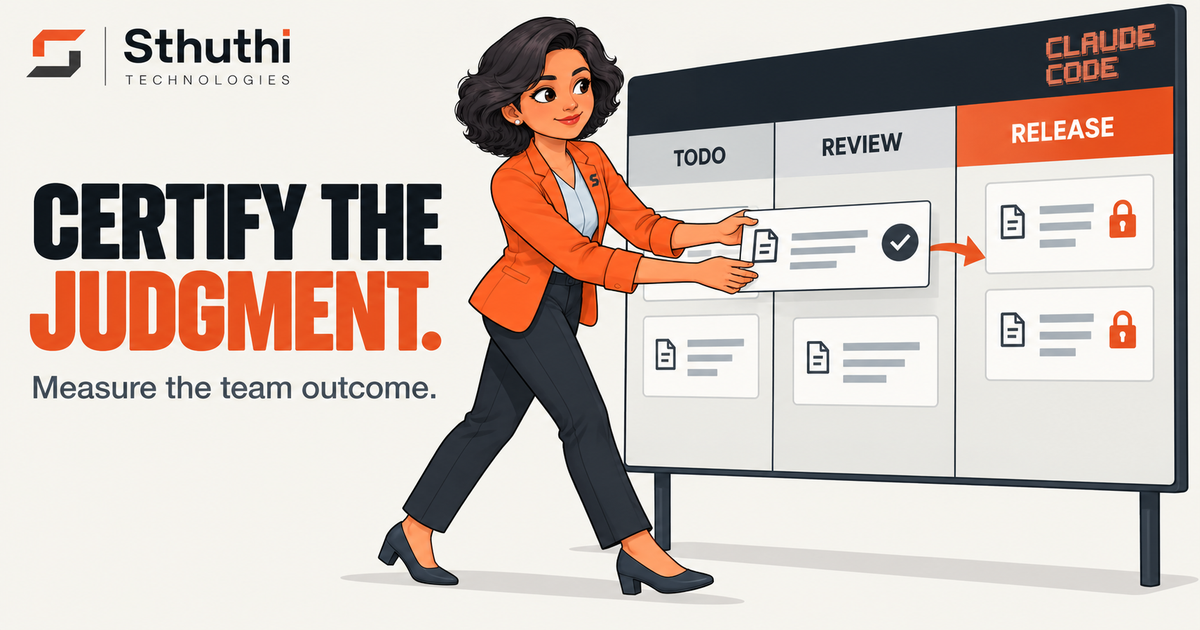
Yes, for teams that already use Claude Code on real software, a practical certification is worth testing in 2026-27. Fund it as a way to check how engineers direct and review AI work, not as a promise of faster releases, protected jobs, or a credential issued by Anthropic. Sthuthi Technologies offers an independent, proctored assessment built around a live repository task; its public pages do not list a cohort price. [1, 2]
- Certification Choice: Sthuthi assesses task framing, diff review, and permissions in a repository; Anthropic's separate developer certification is available through its partner program. → Choose according to the skill you need to check and the issuer a client requires. [1, 3]
- Measured Upside: Three randomized company trials covering 4,867 developers found 26.08% more completed tasks with an AI coding assistant. → Pilot on your own work rather than applying that result to Claude Code or certification itself. [4]
- Delivery Bottleneck: A 2026 study found large gains in code activity but a much smaller gain in releases. → Measure production delivery and rework, not generated lines. [5]
- Quality Risk: Google's 2025 DORA research associated AI use with higher throughput and product performance but lower delivery stability. → Keep testing, code review, and rollback capacity in the investment case. [6]
- Credential Evidence: In a 2026 Pearson VUE survey, 93% of 505 large-organization IT and HR leaders reported positive certification ROI. That is employer-reported evidence across IT certifications, not a result for Sthuthi. → Ask for a measured team pilot. [7]
- Layoff Reality: Through September 2026, U.S. employers had announced 573,195 cuts; AI was cited in 120,136. The figures do not identify which employees knew AI or held certificates. → Do not sell training as layoff insurance. [8]
- Closest Worker Comparison: Gallup found that tech workers using AI less than monthly were three times as likely to have been laid off as those using it at least monthly. That is an association about use, not a comparison of certified and uncertified staff. → Offer training, then track actual skills and redeployment. [9]
- Cost Discipline: SHRM's 2025 average nonexecutive cost per hire was $5,475; its 2026 median time to fill a nonexecutive role was 39 calendar days. → Compare a quoted cohort fee and staff time against a genuine hiring alternative, not an imagined saving. [10, 11]
What Sthuthi sells, and what it does not
The Sthuthi Claude Code track is an independent Sthuthi Technologies certification for engineers working with Claude Code. Its stated audience includes engineers working in production repositories, tech leads reviewing AI-authored changes, and platform teams setting common practice. Delivery combines a cohort and asynchronous work. The track names Foundations, Practitioner, and Expert levels, and finishes with a proctored, in-IDE repository task reviewed by a human assessor. [1]
The assessed work is specific: frame a task with a workable scope, direct Claude Code through a change, inspect the resulting diff for correctness, scope creep, and introduced dependencies, and explain permission boundaries before merge. The accompanying Sthuthi explanation of Claude Code certification says the resulting credential has a verifiable ID. The public pages do not state a tuition price, cohort minimum, course duration, passing score, or quantified improvement in company performance; obtain those details in a proposal. [1, 2]
Anthropic issues a different credential. Its Claude Certified Developer - Foundations exam belongs to the Claude Certification Program, with access through the Claude Partner Network and Anthropic Partner Academy; Pearson VUE lists the program's exams and digital badges. It covers more than Claude Code. Sthuthi explicitly says its own credential is not issued by Anthropic or a substitute for Anthropic's certification. Anthropic's publicly available self-paced courses are another option, but Sthuthi distinguishes course completion from its assessed repository task. [1, 2, 3]
| Decision | Sthuthi Claude Code track | Anthropic certification | Free Anthropic courses |
|---|---|---|---|
| What the company buys | A cohort plus human-reviewed, in-repository assessment of Claude Code practice. [1] | Access to Anthropic-issued exams through the partner program, for eligible organizations. [3] | Self-paced instruction rather than Sthuthi's proctored assessment. [2] |
| Best fit | A team needs evidence that its engineers can scope, review, and control agent work. [1] | A partner needs the issuer and exam accepted by Anthropic's program. [3, 12] | A team needs an initial introduction before deciding whether to pay for assessment. [2] |
| Price to budget | Sthuthi's public pages do not state a price. [1, 2] | Sthuthi's September 2026 guide lists $125 for the developer exam; confirm current eligibility and price with the exam provider. [2] | Sthuthi describes the cited self-paced courses as free. [2] |
The purchase case for Sthuthi is strongest when someone must check work inside a repository. For a firm's Anthropic partner standing, buy the Anthropic-issued qualification that the program recognizes instead. [1, 3, 12]
AI coding can save time; shipping the change is harder
The adoption case is substantial, though not specific to this certificate. In an Anthropic and Material survey published in December 2025, covering more than 500 technical leaders, nearly 90% of organizations said they used AI to assist development and 86% said they used agents for production code. Those are surveyed organizations and self-reports, not a census of all employers or proof that their engineers use Claude Code well. [13]
Cognizant shows how large the rollout decision can become. In November 2025 it announced plans to make Claude available to up to 350,000 employees, including engineering and delivery teams using Claude Code for coding, testing, documentation, and DevOps. That announcement establishes intended scale, not realized speed or a certification outcome. An engineering head planning a similar rollout needs to know who can approve commands, judge a diff, and stop an agent when it exceeds the task. [1, 14]
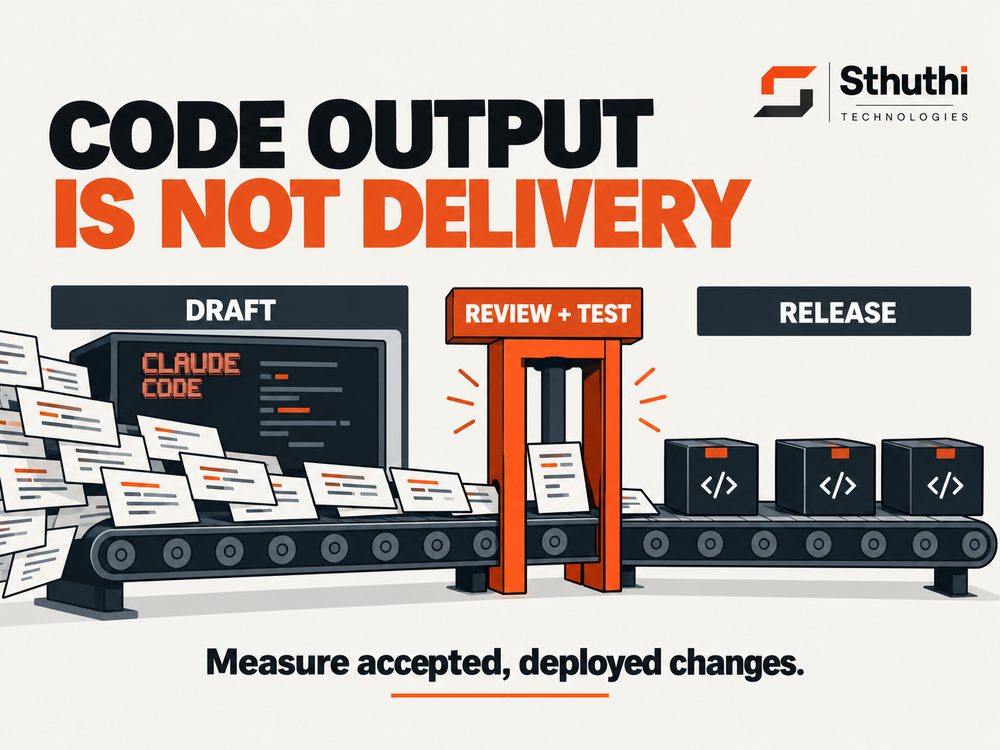
The best experimental evidence supports a plausible productivity benefit, with limits. Three company-run randomized field experiments at Microsoft, Accenture, and a Fortune 100 company involved 4,867 developers; combined analysis found 26.08% more completed tasks with an AI coding assistant. The experiment tested access to an assistant suggesting code completions, not completion of Sthuthi's program. A separate 2026 observational study of coding-tool generations found that output rises much faster than releases. [4, 5]
| Evidence and date | Result | What a buyer should conclude |
|---|---|---|
| Microsoft Research company trials, June 2025 | Across 4,867 developers, AI access was associated in the randomized experiments with 26.08% more completed tasks. [4] | A credible productivity signal, not a predicted gain from Claude Code training. |
| Anthropic and Material enterprise survey, December 2025 | 80% of surveyed organizations reported measurable economic returns from agent investment. [13] | Useful market signal; self-reported returns need an internal check. |
| NBER working paper, revised September 2026 | With synchronous agents, lines of code rose 958%, pull requests 86%, and releases 20%. [5] | Added code is a poor substitute for shipped value. |
| METR experienced-developer trial, July 2025 | Sixteen developers completed 246 issues and took 19% longer with AI; submitted PR quality was similar. [15] | Some work and users can get slower. |
| METR follow-up, February 2026 | Results from 57 developers and more than 800 tasks suggested possible speedups, but estimates were uncertain and participation bias complicated interpretation. [16] | Retest as tools and users change; do not freeze a 2025 estimate into a 2027 budget. |
Doctolib supplies a concrete company example, with an important qualification. In Anthropic's December 2025 enterprise report, Doctolib reported replacing legacy testing infrastructure in hours rather than weeks and shipping features 40% faster. That is a reported company result presented by a tool vendor, not an independent estimate of what certification added. [13]
For a CTO, the useful question is whether a trained team can reproduce a gain in comparable work without adding incidents or review burden. Select representative issues, record the baseline from request to accepted and deployed change, and compare the certified cohort with similar work under the same release rules. The observed gap between generated code and releases makes that last condition essential. [5, 6]
Review discipline is part of the return
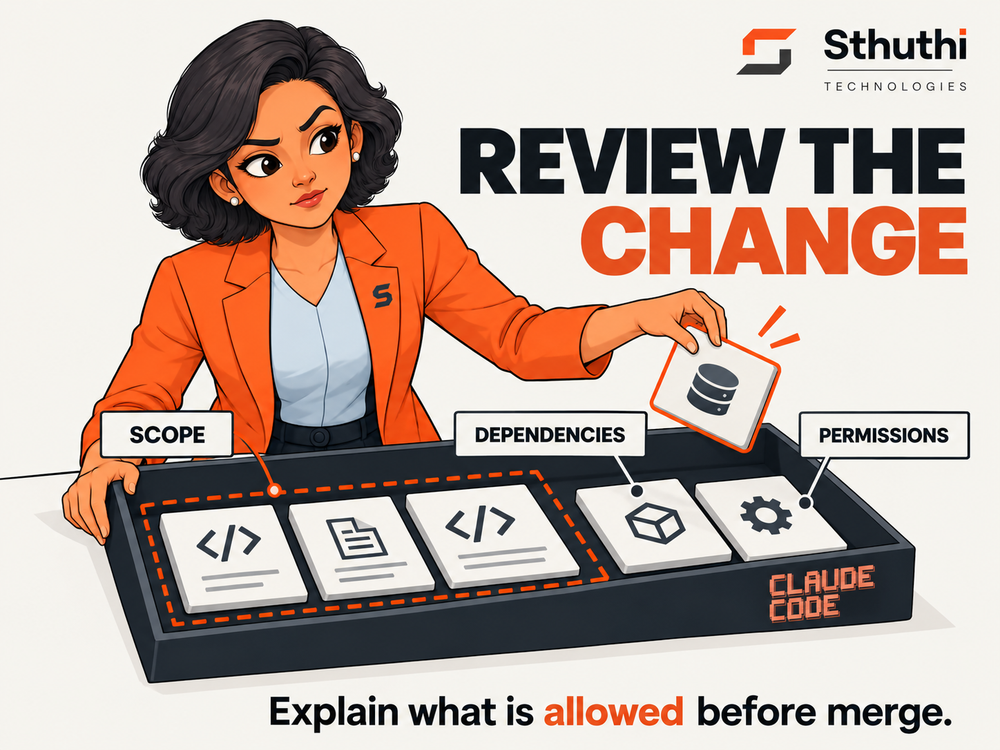
Faster drafting can leave a slower, riskier queue for reviewers. Google's September 2025 DORA analysis used responses from nearly 5,000 technology professionals and over 100 hours of qualitative research. It found a positive relationship between AI adoption and software-delivery throughput and product performance, but a negative relationship with delivery stability. Its account stresses testing, version control, and fast feedback as safeguards. These are associations across teams, not a controlled estimate for one product. [6]
Developer sentiment points to the same operational problem. Stack Overflow's 2025 survey had more than 49,000 responses. In its survey presentation, 46% of developers distrusted AI output accuracy versus 33% who trusted it; 66% cited solutions that were almost right as a frustration, and 45% cited time-consuming debugging of generated code. Those measures describe respondents, not the defect rate in a company's repository. [17]
A security test gives a narrower but sharper warning. Veracode's 2025 benchmark tested more than 100 models on 80 specified coding tasks across four languages and four classes of weakness; 45% of generation tasks introduced a known security flaw. It does not mean 45% of all code written with AI is vulnerable. It does mean a company should not treat a passing test or an agent's confident explanation as a security review. [18]
Sthuthi's choice to test diff review and permissions is therefore well matched to a real bottleneck. Anthropic's Claude Code documentation describes approval controls for actions, a read-only starting mode in manual operation, sandbox isolation for commands, and organization-managed settings. Its enterprise offering describes role-based access, audit controls, and usage telemetry. Training should check whether people use those controls appropriately; buying an enterprise plan alone does not show that they do. [1, 19, 20]
For a production team, require the assessor's task to include an ambiguous request, an out-of-scope change, a dependency or command requiring judgment, and a written explanation of the final diff. Those are proposed purchasing criteria, not claims that every Sthuthi assessment currently contains those exact test cases. Ask Sthuthi to map its rubric to the company's own risk controls. [1]
Hiring, promotion and client trust have different tests
A certificate can reduce uncertainty when a manager cannot watch every candidate work. Pearson VUE's 2026 employer report surveyed 505 IT and HR leaders in organizations with at least 1,000 employees across seven countries; 93% reported positive certification ROI, and respondents said they evaluated it using employee performance, customer satisfaction, and retention. The finding captures employers' assessments of IT credentials generally. It does not show that an engineer who completes Sthuthi's track earns more, gets promoted, or stays longer. [7]
Evidence of demonstrated skill is a sensible companion to the certificate. An Aspen Institute report from November 2025 surveyed more than 550 employers and found that they wanted evidence of skill demonstration and proficiency; the sample was not representative. Among respondents, fewer than 4% reported no mismatch between applicants' claimed and demonstrated skills. A supervised repository exercise can give a hiring or promotion panel more to inspect than a course-completion line, but its value still depends on the task and assessor. [21]
For consulting firms, the issuer question is especially concrete. Anthropic said in June 2026 that more than 10,000 consultants had earned one of its certifications and that the entry-level Registered partner tier starts with a commitment to 10 certified practitioners. AWS describes certified staff as part of its services-partner tiers; Microsoft lists individual vendor certifications in qualifications for some Solutions Partner designations. These are examples of how recognized certifications enter partner requirements. None establishes that a Sthuthi-issued credential satisfies an Anthropic, AWS, or Microsoft requirement, or automatically qualifies a firm for a tender. [12, 22, 23]
A services firm can still use an independently assessed cohort to show clients its team's working method: who scoped the request, reviewed the change, checked permissions, and approved the merge. For a tender that names an issuer or exam, check the exact requirement before claiming compliance. No credible evidence here establishes a higher billing rate or a won RFP caused by holding Sthuthi's certificate. [1, 3]
Layoffs and AI skills: the comparison buyers can actually make
The U.S. layoff picture has two distinct measurements. Challenger, Gray & Christmas reported in October 2026 that employers had announced 573,195 cuts through September, 165,925 of them in technology. Employers cited AI in 120,136 of those announcements, about 21%. These are announced cuts sorted by employers' stated reasons, not a verified count of people replaced by a model; the report does not record individual workers' AI skill. [8]
Gallup's June 2026 worker survey asked a different question. Only 1% of its currently laid-off respondents cited AI or automation as the primary cause, while other respondents cited restructuring, cost-cutting, or elimination of a role. Gallup also found that tech workers who used AI less than monthly were three times as likely to have been laid off as those using it at least monthly. The two sources need not agree on an AI-layoff count: one codes employer announcements, the other asks workers about their situation and use. Neither tests certification, and frequent AI use could reflect differences in role, employer, seniority, or demand rather than cause job security. [8, 9, 24]
Block illustrates why a certificate cannot be marketed as protection. In its Q4 2025 shareholder letter, Block described reducing its workforce by more than 40% and moving toward smaller, AI-native teams. The company linked that decision to how AI changes product development and to its goal of improving operating leverage. The letter does not sort departing employees into AI-proficient and non-proficient groups. Management chose a different staffing model; no published statistic in that letter tells us what a Claude Code credential would have done to an individual's outcome. [25]
Cognizant, by contrast, announced a plan to put Claude within reach of up to 350,000 employees, including engineering and delivery staff. That is a deployment plan, not evidence of how many jobs it saved. The contrast is a decision for 2026-27 leadership: decide which tasks should disappear, which people can move to new work, and which skills must be checked before expanding access. Certification can support the last decision, but does not settle the first two. [1, 14]
Forward-looking forecasts are not 2027 layoff counts. In the World Economic Forum's January 2025 employer research, 77% of surveyed employers planned AI-related upskilling by 2030, while 41% planned workforce reductions as AI automated tasks. Those are plans over a longer horizon, not measured future cuts or odds that a certified employee will keep a job. [26]
Put a price on training before claiming savings
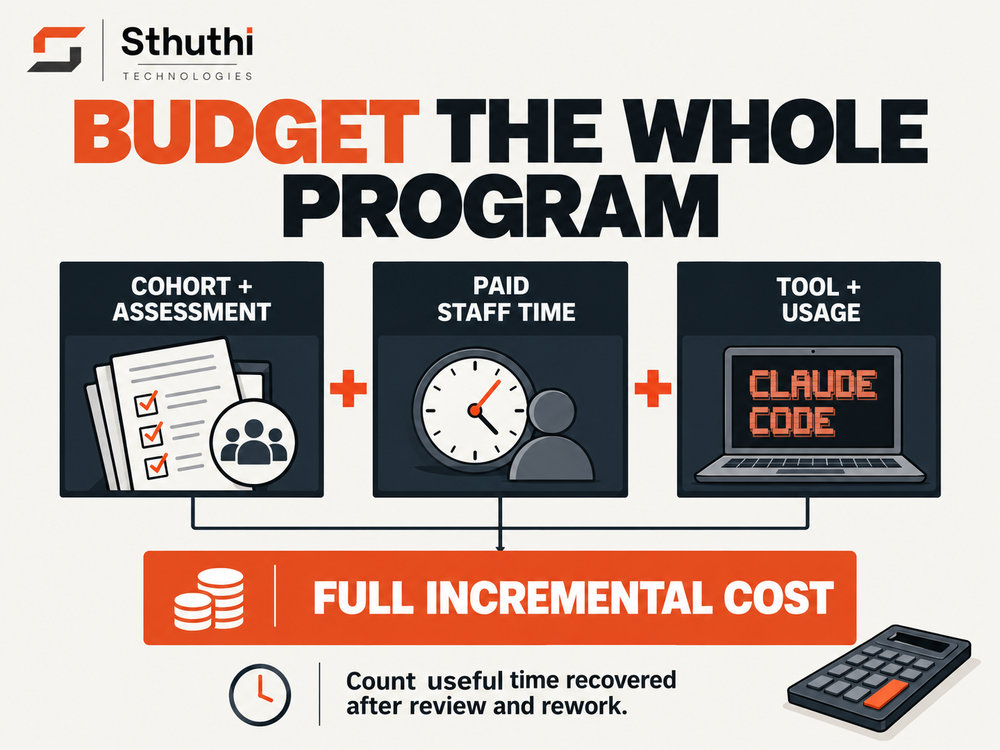
Budget three separate items: assessment and cohort fees from Sthuthi, employees' paid learning and assessment time, and Claude access and usage. Sthuthi does not publish the first item on the two cited pages. Anthropic currently displays a Team Claude Code offering at $100 per person per month with a two-person minimum and applicable usage limits; a separate Enterprise pricing page shows $20 per seat per month plus usage billed at API rates. Those are tool prices, not tuition, and different plans have different cost and control structures. Confirm the plan and quote before comparing options. [1, 2, 20, 27]
Here is an illustrative budget, not a measured Sthuthi price or a promised return. Suppose 25 engineers each spend 12 paid hours on learning and assessment, their fully loaded time costs $80 an hour, and the company buys 25 Team seats for six months at the displayed $100 monthly rate. Staff time costs 25 x 12 x $80 = $24,000; seats cost 25 x 6 x $100 = $15,000. Total: $39,000 plus the Sthuthi quote and any added usage. At $80 per productive hour, covering this example's $39,000 takes 487.5 net productive hours over 26 weeks, or 0.75 hour per engineer per week, before the cohort quote and extra usage. The $100 seat price comes from Anthropic; every other input in this example is an explicit assumption. [20]
Do not count every minute an assistant saves as an hour of billable output. If only half of an estimated time saving converts to useful work, the example needs 1.5 gross hours saved per engineer per week, plus enough to pay the cohort quote. If seats would have been bought anyway, remove their $15,000 from the incremental training decision. Conversely, add rework, security, and review costs if they rise. Evaluate accepted changes, releases, incident work, and engineer time, not prompt counts. [5, 6]
Layoff-and-rehire arithmetic needs the same honesty. SHRM's October 2025 benchmark put average nonexecutive cost per hire at $5,475; its 2026 report put median nonexecutive time to fill at 39 calendar days. The first is an overall recruiting benchmark, not a software-engineer replacement bill. Neither figure includes a verified severance or productivity cost for this hypothetical team. Compare training with replacement only where a real role and hiring plan exist, then enter the company's own severance, vacancy, ramp-up, and salary numbers. [10, 11]
Roll out a cohort that produces evidence, not just badges
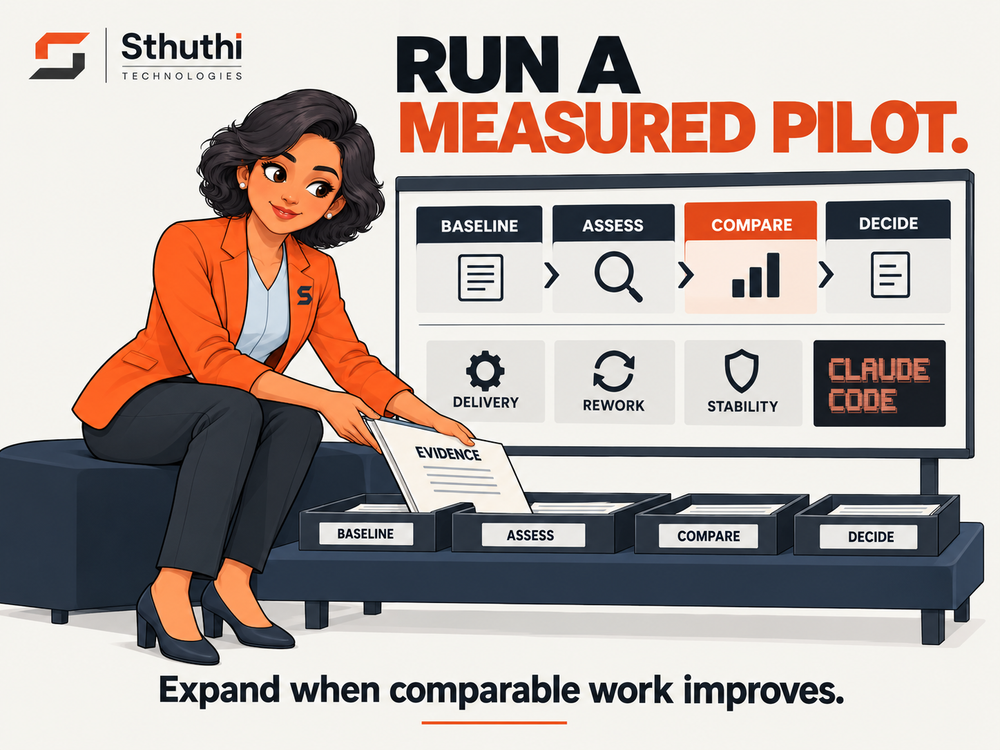
Start with a small group that already handles live repository work: engineers, reviewers, and a platform lead. Use Sthuthi's stated cohort-plus-asynchronous format and its Foundations, Practitioner, and Expert levels to put new users and experienced reviewers against suitable expectations. Before signing, request a written quote, calendar, assessment rubric, rules for reassessment, sample credential-verification process, and treatment of company code in assessment. The public pages describe the format and a verifiable ID, but not those commercial and operational details. [1, 2]
Record a baseline for comparable work before training: time from accepted request to deployment, review time, rework, escaped defects, incidents, and tool spend. For the assessment, use an approved repository or safe replica. Require the engineer to explain scope, the diff, testing, dependencies, and why particular tool permissions were allowed. The Sthuthi track explicitly focuses on task framing, diff review, and guardrails, so those are the natural checks to agree with its assessor. [1]
Run the cohort alongside the controls the team must actually use. Anthropic documents permission modes, sandboxing, managed settings, and usage monitoring; its enterprise material also describes role-based administration and audit features. Decide what access is allowed before engineers work on sensitive repositories. Then have reviewers inspect assessment artifacts rather than treating a certificate ID as a substitute for their approval. [19, 20]
After the pilot, ask whether assessed engineers ship comparable changes faster without worse stability, and whether clients or internal managers can use the assessment evidence. If the answer is yes, expand by repository and role. If the benefit is mainly familiarity with a tool, start more people with Anthropic's free courses and reserve paid assessment for production users and reviewers. [2, 6]
The bottom line
The cases point to different decisions, not a single AI staffing rule. Cognizant's announced scale is about access; Doctolib's reported faster delivery is about a particular workflow; Block's workforce cut is about its chosen organization design; Sthuthi's assessment is about whether a particular engineer can direct and check work. Their scope, evidence, and time horizons differ. A company cannot infer from Cognizant's access plan that releases will speed up, from Doctolib's report that a certificate caused the gain, or from Block's decision that a certificate prevents a cut. [1, 13, 14, 25]
The clearest tension is that AI can increase task output while leaving production bottlenecks and review risk behind. The randomized developer trials support more completed tasks, while the NBER study shows a much smaller rise in releases than in code activity and DORA associates AI adoption with lower stability. Sthuthi's emphasis on diff review and permissions addresses a plausible gap in that chain. Whether its particular cohort closes the gap for your firm remains a question to measure, not a benefit to assume. [1, 4, 5, 6]
For a company using Claude Code in production in 2026-27, the strongest case is a limited, paid pilot with a clear assessment rubric, security rules, and an agreed delivery measure. For a consulting firm chasing formal partner standing, check Anthropic's issuer requirements separately. Review the Sthuthi Claude Code track and its guide distinguishing the available credentials, then request a cohort quote tied to the repositories and review decisions your team must handle. [1, 2, 3]
Ready to scope a pilot? Here's how to certify your team on Claude Code, starting with 10 to 20 engineers. See also the Claude Code certification track, read what Claude Code certifications actually exist, or how to build the business case. Training students rather than employees? See the student programme.
Sources
- Claude Code Certification Training for Teams | Sthuthi Technologies
- Is there a Claude Code certification? Here's what actually exists | Sthuthi Technologies
- Claude Certification Program | AI, Machine Learning & LLM Development
- The Effects of Generative AI on High-Skilled Work: Evidence from Three Field Experiments with Software Developers - Microsoft Research
- Writing Code vs. Shipping Code: Productivity Effects Across Generations of AI Coding Tools (NBER)
- Announcing the 2025 DORA Report | Google Cloud Blog
- 2026 Value of IT Certification Employer Report
- Challenger Report, September 2026
- Gallup: U.S. Workers Continue to Report Downsizing
- SHRM Releases 2025 Benchmarking Reports: How Does Your Organization Compare?
- 2026 Recruiting Executives Benchmarking: Attracting Critical Talent
- Claude Partner Network Services Track and Partner Hub (Anthropic)
- How enterprises are building AI agents in 2026 | Claude by Anthropic
- Cognizant brings Claude to 350,000 employees (Anthropic)
- Measuring the Impact of Early-2025 AI on Experienced Open-Source Developer Productivity - METR
- We are Changing our Developer Productivity Experiment Design - METR
- 2025 Stack Overflow Developer Survey
- GenAI Code Security Report
- Claude Code security documentation
- Claude Code for Enterprise | Claude by Anthropic
- The Case for Skills: What Employers Want and Need
- AWS Partner Services Tiers
- Solution Partner Designation qualification criteria - Partner Center | Microsoft Learn
- Challenger Report: Layoffs Fall, Hiring Picks Up; AI Leads For Fifth Straight Month
- Q4 2025 Shareholder Letter
- Future of Jobs Report 2025: 78 Million New Job Opportunities by 2030 but Urgent Upskilling Needed to Prepare Workforces > Press releases | World Economic Forum
- Claude pricing
Weighing training options? See Claude Code workshops vs assessed certification and all Claude Code certification alternatives.
Planning the rollout itself? Use our 90-day Claude Code rollout playbook or, for Indian delivery teams, see Claude Code certification for IT services companies.
Frequently asked questions
Is Sthuthi's certificate an official Anthropic certification?
No. Sthuthi calls it an independent assessment. Anthropic's own program has separate exams and partner-access rules.
Will it get an engineer hired or promoted?
A practical, reviewable task gives a manager more evidence than an unsupported skills claim, but no study establishes a hiring or promotion lift caused by this credential. Assess the engineer's work as well as the certificate.
Will clients pay a higher rate or accept it in an RFP?
That has not been established. Anthropic's partner program and other vendor programs have their own recognized credentials and requirements, so ask each buyer which issuer and evidence it accepts.
Does AI proficiency prevent layoffs?
No such claim is supported. Gallup reports an association between more frequent AI use and lower observed layoff incidence among tech workers, but that is neither a certification trial nor proof of causation, and employer-reported AI-related cut totals cannot separate proficient workers from others.
How should we budget it?
Request Sthuthi's cohort fee and assessment terms, add paid staff time, then price the actual Claude plan and expected usage. Do not substitute Anthropic's exam price or a Claude seat price for assessment tuition.
Want your team's AI-tool usage actually checked?
See the published certification tracks, or tell us about the tool you're worried about.