
How to build the business case for AI-tool certification
A practical template for the business case for AI training certification: cost data, pilot sizing, ROI math, and a checklist to justify AI certification budget.
September 18, 2026 · 8 min read

Most requests for AI-certification budget die in the same meeting, for the same reason. Someone on the L&D or People Ops side presents a plan to "upskill the team on AI tools," a CFO or VP asks what it actually prevents or enables that isn't already happening, and the answer is some version of "people will be more comfortable with the tools." That's not a business case. It's a hope, and hopes don't survive a budget cycle.
If you already believe your company needs a real certification program — not another course library nobody finishes — the job left is narrower than it feels: turn the belief into a document a finance-minded person would approve without a follow-up meeting. Here's what actually needs to be in it.
Don't pitch "AI literacy." Pitch risk reduction and capability verification.
"AI literacy" is a training-completion pitch — it asks for budget to run a course and counts success in attendance. It's an easy pitch to reject, because nobody can say what "literate" actually means or what it would have prevented. A verified-capability pitch is a different claim: you're asking to find out, with evidence, which specific people can already use these tools safely on real work, and which ones need to be stopped before they ship something that costs more than the training would have.
That reframe matters because it changes what you're asking finance to compare. "Upskilling" competes against every other soft line-item in the training budget. "Verification that our AI-assisted output is safe to ship" competes against the cost of the incident it prevents — a comparison that's much easier to win, and the one this entire pitch should be built around.
What actually goes in the cost-of-inaction section
This is the part most pitches skip, and it's the part that gets approved or rejected. Don't write "AI tools carry risk." Write down what unmanaged AI tool use is already costing companies that haven't checked it, with numbers a CFO can sanity-check against their own exposure.
- Shadow AI has a line-item cost, and it's documented. IBM's 2025 Cost of a Data Breach Report found that breaches involving "shadow AI" — employees using AI tools the company never approved or governed — added an average of $670,000 to the cost of the breach, on top of the baseline. The same report found that 63 percent of organizations have no AI governance policy in place at all. If your company can't currently say who's cleared to use which AI tool on what kind of work, that 63 percent almost certainly includes you.
- The skills gap has a price tag attached to it, too. IDC estimates that AI and technical skills shortages could cost the global economy up to $5.5 trillion by 2026 in delayed products, missed revenue, and lost competitiveness — and separately, more than 90 percent of enterprises expect to face a critical skills shortage in that same window. Whatever fraction of that risk maps to your headcount is a real number, not a hypothetical one.
- Unchecked AI coding usage has its own, separate cost curve. If engineering is any part of the scope, don't re-derive this from scratch — we've already written up the technical-debt and vulnerability data specific to AI-assisted code in the vibe coding tax. Link that piece directly into your pitch instead of summarizing it secondhand — it's built to be handed to exactly this kind of audience.
The point of this section isn't to scare anyone. It's to establish that "do nothing" is not the free option in the comparison — it's a specific, documented, growing number. Once that's on the table, the cost of a pilot program looks small by comparison, which is exactly the comparison you want the reader making.
Shadow AI added $670,000 to the average cost of a breach. 63% of organizations have no AI governance policy to prevent it.IBM Cost of a Data Breach Report, 2025
Size the ask as a pilot, not a program
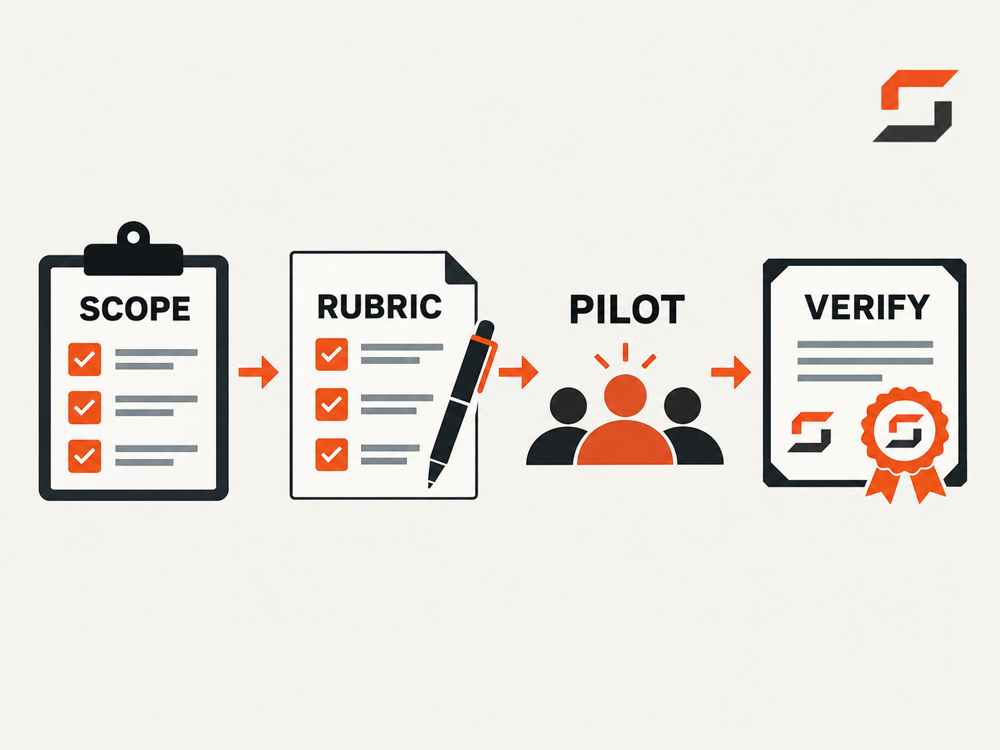
A request for "a certification program" reads as open-ended and expensive. A request for a scoped pilot with a fixed timeline reads as something you can approve this quarter and kill next quarter if it doesn't work. Ask for the pilot.
If you're certifying a team on a published, off-the-shelf track — Claude Code, Codex, GitHub Copilot, Gemini, or Cursor — the sizing question is simple: how many people in the first cohort, and which track. Published tracks run as cohort-plus-async programs with an in-context assessment (an in-IDE task, a scenario review, or the equivalent), so the pilot cost is bounded by cohort size from day one — you're not committing to a headcount-wide rollout to find out if it works. Here's how a pilot works when you certify your team on Claude Code. Still choosing the tool itself? Start with the three questions in choosing the best AI coding assistant for enterprise. Comparing providers? Use our six checks for choosing an AI certification program for employees.
If what you need to certify is an internal or proprietary tool — a custom LLM wrapper, an in-house agent framework, a locked-down Copilot fork — the timeline is different but just as boundable. A custom track runs on a four-stage clock: a scoping call in week one to define what a certified person should actually be able to do, a rubric your own engineering leads sign off on in weeks two and three, a pilot cohort in week four to stress-test the rubric against real people, and only then a standing track on your own calendar. Nothing scales past a single pilot cohort until your own people have approved the rubric it's scored against. Put that timeline in the pitch verbatim — it's the difference between "we're evaluating an open-ended vendor engagement" and "we're approving a four-week pilot with a defined exit point."
Present the credential as an asset, not a line-item that disappears after the training ends
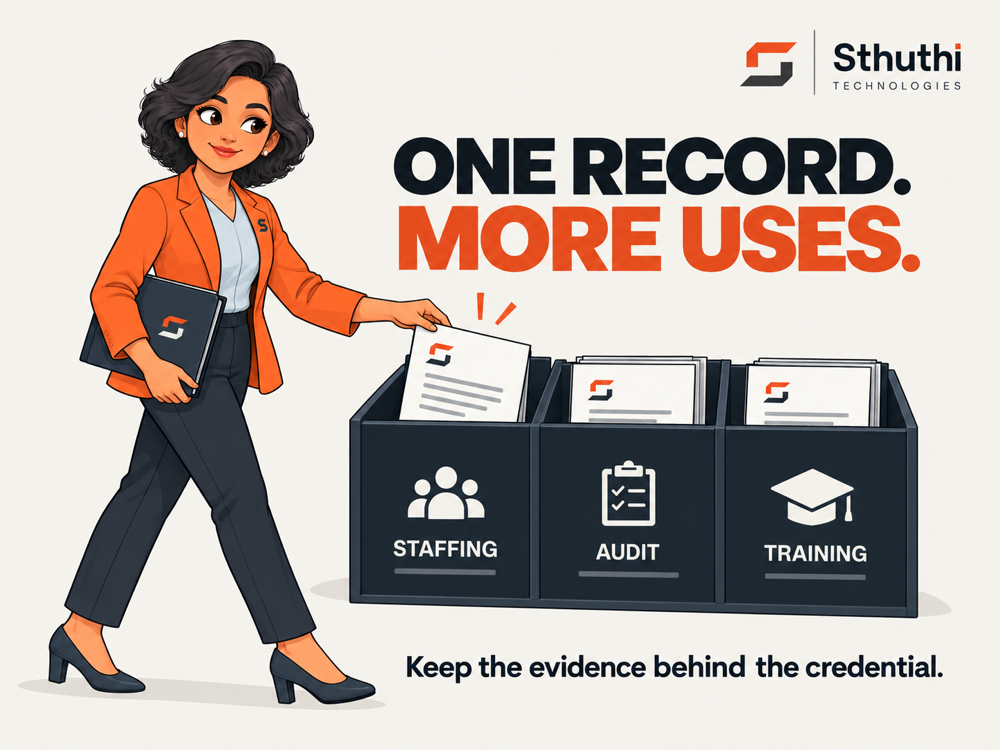
A course-completion certificate is a sunk cost the moment the course ends — it has no ongoing use to the business. A verified credential is different, and that difference belongs in the pitch: it's an HR-referenceable, individually verifiable record that a specific person was checked against a specific standard, on a specific date, by a proctor — not a badge that only confirms someone watched a video to the end.
That matters for the ROI case in two concrete ways finance will recognize. First, it's an asset that shows up in later decisions — staffing a project that touches sensitive code or client data, deciding who onboards new hires onto an AI-assisted workflow, responding to a customer or auditor who asks how you know your team uses these tools safely. Second, it depreciates slowly: a rubric gets revisited when the underlying tool changes meaningfully, not on an arbitrary annual cycle, so you're not re-buying the same credential every year to keep it current.
Put a number on it: the ROI math to actually show your finance team
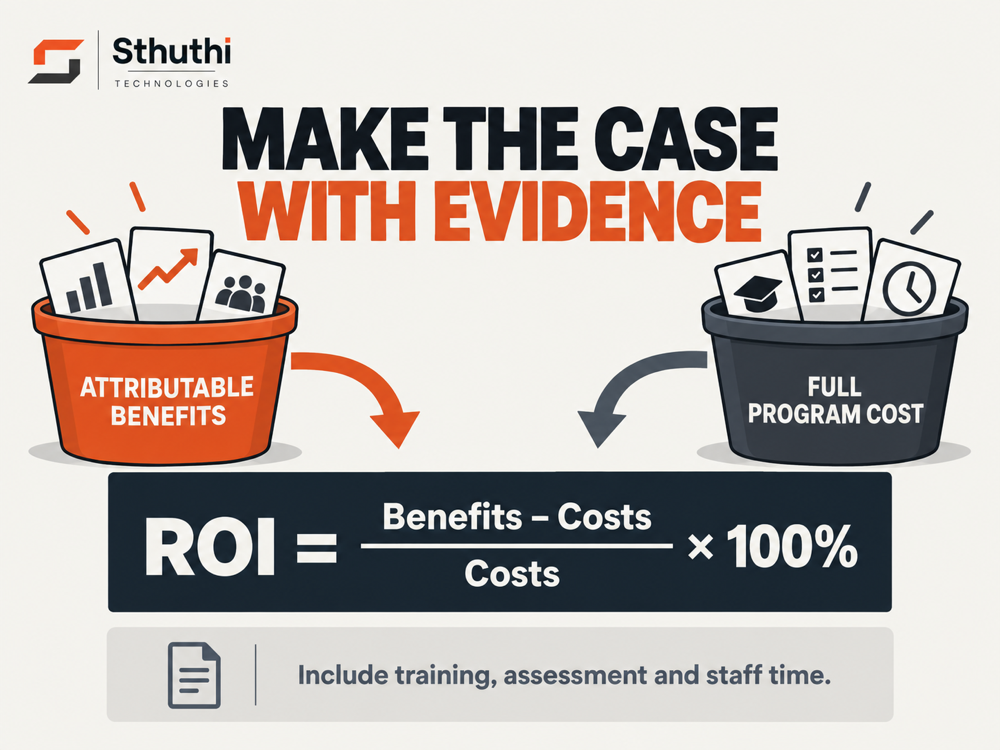
You don't need a novel formula here — using a recognized one makes the pitch more credible, not less. The standard approach, the Phillips ROI Methodology, extends the familiar four-level training evaluation (reaction, learning, application, business impact) with a fifth level that isolates the program's financial return:
ROI (%) = (net benefits of the program ÷ total program costs) × 100
For a certification pilot, "net benefits" is the estimated cost of the incidents, rework, or lost time the credential is meant to catch or prevent — pull that from the cost-of-inaction section above — minus the pilot's cost. "Total program costs" is the pilot spend itself: the assessment fee or cohort cost, the time your engineering leads spend on rubric sign-off, and the paid time candidates spend being assessed. You don't need to model this precisely to make the case — a range with your assumptions labeled is more credible to a finance reviewer than a single confident number with no visible math.
The one-page version: a checklist to actually draft from
If you're turning this into an internal document today, it needs these six things, in this order, and nothing else:
- The specific claim you can't currently make — e.g. "we don't know which of our 40 engineers would catch a scope-creeping diff from Claude Code before it merges."
- The cost of not knowing — your shadow-AI / governance exposure, the skills-gap number that applies to your headcount, and (if relevant) a link to the AI-coding-specific data rather than a rewrite of it.
- The pilot scope — one track, one cohort size, one fixed timeline (four weeks for a custom track; a single cohort cycle for a published one).
- The pilot cost — the actual number, not "TBD."
- The ROI range — using the Phillips formula above, with your assumptions stated, not hidden.
- The exit criteria — what the pilot has to show to justify turning it into a standing track, decided before it starts, not after.
That's a document a CFO can act on in one sitting, because every line answers a question they'd otherwise have to ask.
If you want to build that pitch around a published track, the list of current certification tracks has the levels, format, and assessment type for each tool. If what you need to certify doesn't exist as a published track yet, the custom certification page walks through the same four-week timeline referenced above in more detail. Either way, if you'd rather talk through the pilot scope and pricing before you draft the internal pitch, get in touch and we'll help you size it.
For a Claude Code-specific version of this argument, with budget arithmetic and the evidence on productivity and layoffs, read should companies certify their Claude Code teams in 2026-27.
Frequently asked questions
What's the difference between pitching this as "AI literacy" versus "risk reduction"?
"AI literacy" asks for budget to run a course and measures success by attendance — it's easy to reject because nobody can define what "literate" means or what it prevents. A risk-reduction pitch asks for budget to verify, with evidence, which specific people can already use these tools safely, competing against the cost of the incident it prevents rather than against every other soft training line-item.
How much does unmanaged "shadow AI" actually cost a company?
IBM's 2025 Cost of a Data Breach Report found that breaches involving shadow AI — employees using AI tools the company never approved or governed — added an average of $670,000 to the cost of the breach, and that 63 percent of organizations have no AI governance policy in place at all.
How do I calculate ROI for a certification pilot?
Use the Phillips ROI Methodology, which extends standard training evaluation with a financial level: ROI (%) = (net benefits of the program ÷ total program costs) × 100. Net benefits are the estimated cost of the incidents or rework the credential is meant to catch, minus the pilot's cost; total costs are the assessment fee, rubric sign-off time, and paid assessment time.
Want your team's AI-tool usage actually checked?
See the published certification tracks, or tell us about the tool you're worried about.