
Why only 11% of employees can accurately self-assess their AI skills
A Workera analysis of 22,000+ skills assessments found only 11% of employees rate their own AI ability accurately. Here's the research, and the fix.
September 18, 2026 · 8 min read
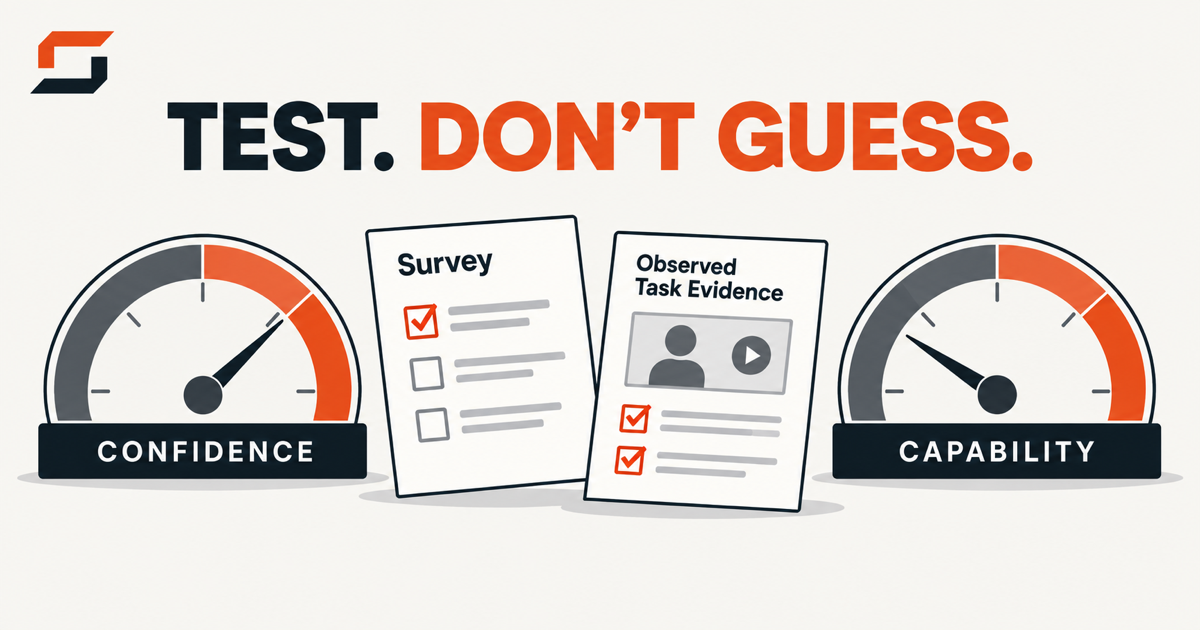
Ask a room of employees how good they are with AI tools, and 89 percent of the answers you get back will be wrong. Not "wrong" in a loose, rhetorical sense — wrong against an actual skills test taken by the same people who answered the survey question. That number comes from the one organization that has run both instruments on the same population at scale: a self-report, and a proctored assessment, side by side, on tens of thousands of workers. The gap between what people say and what they can do is the finding, and it's a lot wider than most L&D and engineering leaders assume when they build a readiness plan around "just ask the team."
What the self-assessment research actually found
The number traces back to a Workera analysis of anonymized data from several thousand users who together completed more than 22,000 domain assessments through early 2024, spanning technical subjects including machine learning, generative AI, and communicating about AI. Before taking Workera's computerized adaptive test (CAT) — an assessment that adjusts question difficulty in real time based on how a person is performing — each user rated their own proficiency in that domain on the same 300-point scale the test uses. Workera then compared the two numbers. "Accurate" was defined generously: a self-rating within 10 points of the test result.
Only 11 percent of users landed inside that window. Fifty-six percent underestimated their own ability; 32 percent overestimated it. Seven in ten people, in other words, couldn't put a number on their own skill that came within shouting distance of what a real assessment measured — in either direction.
The pattern wasn't uniform across domains, and the shape of it is useful. In machine learning — a narrow, technical subject with a right and wrong answer — 55 percent of users rated themselves accurately and only 17 percent underestimated. In "communicating about AI," a fuzzier, more socially-inflected skill, accuracy dropped to 27 percent and 69 percent of users lowballed themselves. Workera's own read on this: the more technical and checkable a skill is, the better people are at judging where they stand on it. The vaguer and more subjective a skill sounds, the worse the self-rating gets — and "how comfortable are you with AI tools" is about as vague and subjective a question as a survey can ask.
This isn't a one-off finding Workera has quietly moved past either. In its 2026 AI Skills Enterprise Benchmark Report — 88,753 assessments across 32,422 individuals at enterprises including Fortune 500 companies and U.S. federal agencies — the same 11 percent figure resurfaces as live context for a new and more specific problem: only 13 percent of employees tested as "Accomplished" in agentic AI skills before any upskilling, the lowest score of the 14 capability areas the report measured. We covered that 13 percent stat in the vibe coding tax. What that earlier post didn't get into is the other half of Workera's finding, sitting right next to it: 85 percent of L&D leaders say they're confident in the self-reported skills data they already collect. Confidence in the instrument and accuracy of the instrument are apparently unrelated.
Only 11% of employees can accurately assess their own skill level — yet 85% of L&D leaders are confident in the self-reported data they collect.Workera, 2026 AI Skills Enterprise Benchmark Report
Why this happens
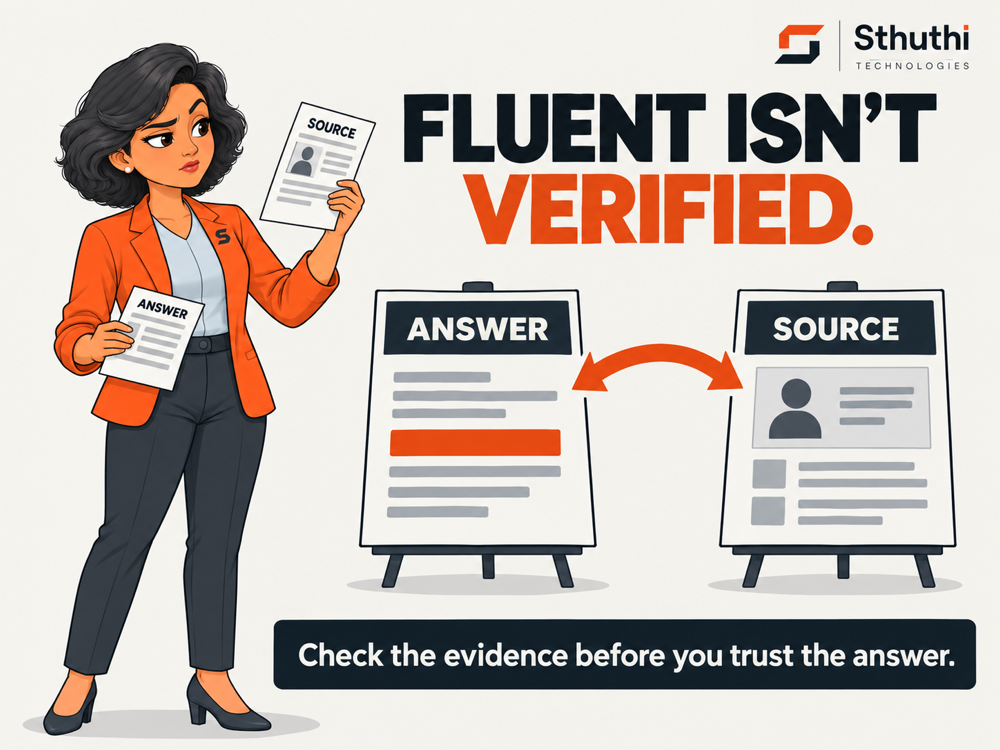
Some of this is the classic Dunning-Kruger pattern — people with the least ability in a domain lack the exact knowledge needed to notice their own gaps. But AI tools appear to produce a variant of the effect that runs in a different direction, and it's arguably worse for a workplace context: using AI seems to make people's self-assessment less accurate, not more, and the effect is strongest among people who already think of themselves as AI-savvy.
A study out of Aalto University, led by assistant professor Robin Welsch with doctoral researcher Daniela da Silva Fernandes, published in Computers in Human Behavior in October 2025, put roughly 500 participants through logical reasoning tasks drawn from the LSAT, half with ChatGPT and half without, then had everyone rate their own performance — with a financial incentive for rating accurately. Participants who used ChatGPT significantly overestimated how well they'd done, and unlike the standard Dunning-Kruger effect, the overconfidence wasn't concentrated among the weakest performers — it showed up across the board. The researchers also found a reversal worth sitting with: participants who considered themselves more AI-literate were more overconfident about their results, not less. As Welsch put it, "higher AI literacy brings more overconfidence" — the people most likely to describe themselves as power users on a self-assessment survey are, per this study, the ones least equipped to judge their own output accurately.
Part of the mechanism is what the researchers call cognitive offloading: most participants sent ChatGPT a single prompt per question and never circled back to check, double-check, or push on the answer. The AI's fluency substitutes for the user's own verification step, and fluent output reads as correct output even when it isn't — which is a fair description of what a scope-creeping diff or a subtly wrong refactor looks like right up until someone actually tests it.
What this means for a company using "ask the team" as a gauge
If your AI readiness plan runs on a survey — "how comfortable are you with Claude Code / Copilot / Cursor, 1 to 5" — the research above says that instrument is measuring confidence, not competence, and the two are only weakly related. That's not a hypothetical risk. A 2025 Skillsoft Global Skills Intelligence Survey of 1,000 HR and L&D professionals found that 91 percent of organizations say employees routinely overstate their skills, most commonly in technical and AI expertise specifically — and that this overstatement makes existing skills gaps worse (36 percent of respondents), cuts productivity (34 percent), and adds to manager stress (31 percent). Skillsoft's separate Workforce Readiness Report: AI Edition — 2,000 respondents across North America, the UK, and Germany — found a 53-point gap between how confident leaders are that their organization has set employees up to use AI well (77 percent) and how equipped employees actually feel (24 percent), and that only 11 percent of employees report ever having received a formal skills assessment at all. Two different studies, two different "11 percent" findings, pointing at the same structural gap from opposite ends: almost nobody is being tested, and almost nobody can accurately report on themselves in the absence of a test.
Put a number on what that costs a specific rollout and it looks like what we described in the vibe coding tax — technical debt, duplicated code, and security defects climbing alongside adoption, not despite it. A comfort survey can't catch any of that in advance, because comfort and capability were never the same variable. It also cuts the other way: a chunk of your team is underrating itself into skipping training or projects they're actually ready for, per the 56 percent underestimation figure above, which is its own quiet cost.
What an actual proficiency check looks like instead
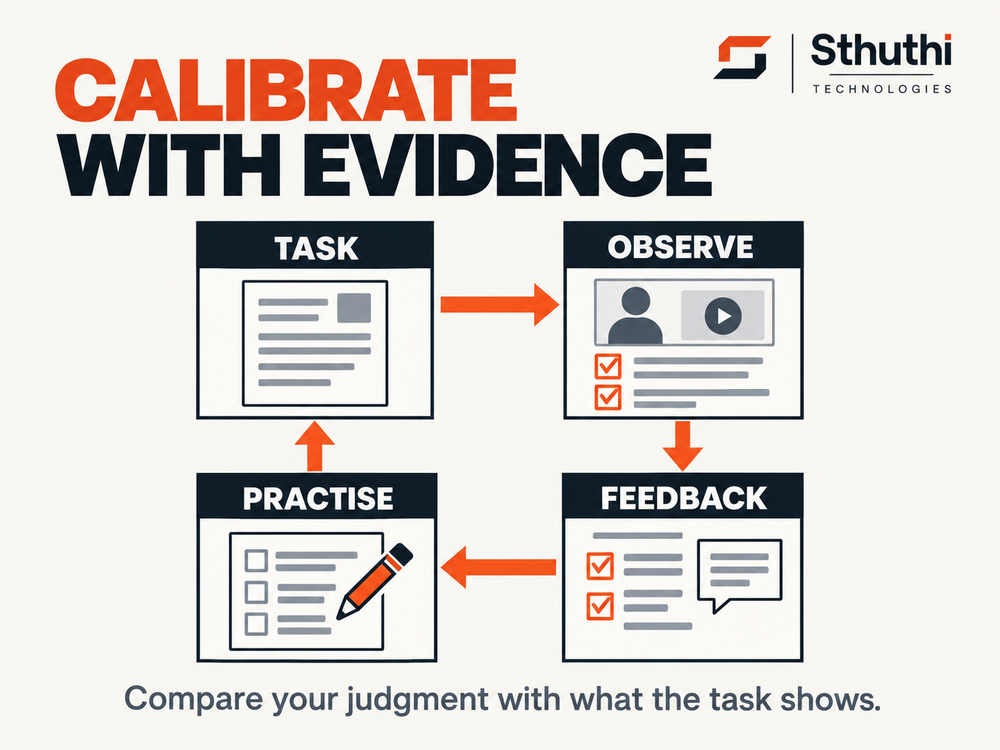
Every study cited here reaches the same structural conclusion: self-report is unreliable specifically because it isn't checked against anything. The fix isn't a better-worded survey question — a five-point Likert scale on "AI comfort" has the same blind spot at any resolution. The fix is replacing the self-report with a task the person actually has to complete, observed by someone or something that scores the outcome rather than the confidence.
That means, concretely:
- A real task, not a question bank. Workera's own CAT methodology gets closer to reality than a survey by adapting to performance in real time, but a live task against a real repository or workflow — not a bank of multiple-choice questions about a tool — is the harder, more direct version of the same idea.
- Proctoring or scored observation. Unsupervised, self-paced "assessments" reintroduce the exact self-report problem they're supposed to solve, just with extra steps.
- A pass/fail or scaled result tied to the work itself — did the diff ship clean, was the scope held, was a bad suggestion caught — not a self-rated confidence score collected afterward.
- Coverage of the judgment calls, not just tool familiarity. Knowing the keyboard shortcuts in Cursor or the slash commands in Claude Code is not the same skill as knowing when to stop trusting the agent's output, and a proficiency check that only tests the former will pass people who fail at the latter.
That's a materially different exercise than reading Workera's or Skillsoft's reports and nodding along. It requires an assessment built the way those studies were — against real performance, scored by something other than the test-taker.
How Sthuthi builds that check
This is the entire premise behind how we run certification: a proctored, task-based assessment against a real tool and a real repository, not a confidence survey and not a self-paced course that ends in a completion badge. A candidate doesn't rate how comfortable they are with Claude Code, Copilot, Cursor, Codex, or Gemini — they use it, on a scoped task, while someone checks whether the result and the judgment behind it actually hold up. See our full list of certification tracks for what that looks like tool by tool, or get in touch if you want to talk through certifying a specific team instead of guessing from what they put on a survey.
Sources: Workera's 2024 self-assessment accuracy analysis, its 2026 AI Skills Enterprise Benchmark Report, the Aalto University study on AI use and overconfidence in Computers in Human Behavior, and Skillsoft's 2025 Global Skills Intelligence Survey and Workforce Readiness Report: AI Edition.
If you want to check how well your own engineers use an AI coding tool, the Claude Code certification track replaces self-rating with an observed, assessed task. For other tools or a whole department, see our AI skills assessment for employees.
Want your team's AI-tool usage actually checked?
See the published certification tracks, or tell us about the tool you're worried about.