
Cursor vs Claude Code for Teams: Which One to Standardise On
Editor-first or agent-first? How Cursor and Claude Code differ for a team on review load, governance and cost, and when running both makes sense.
October 9, 2026 · 8 min read
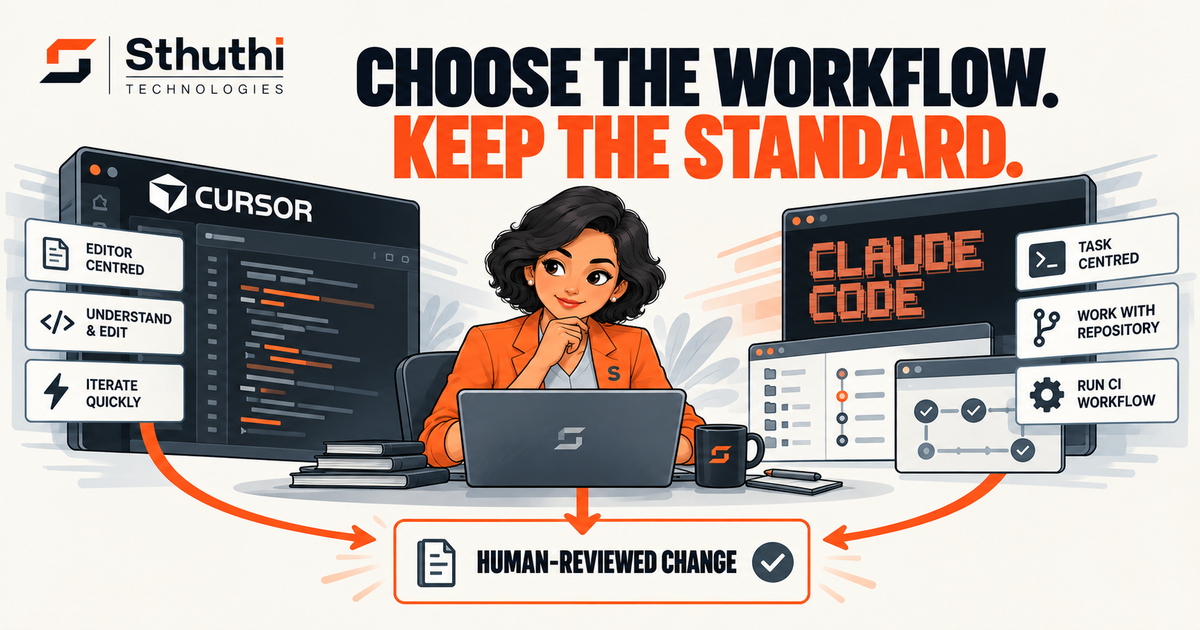
Cursor and Claude Code can both plan and make multi-file changes, so for a team the real difference is shape, not raw ability. Cursor is editor-first: an AI code editor where the agent lives next to the code your engineers already have open. Claude Code is agent-first: one engine that runs in the terminal, IDEs, a desktop app, the web and CI. Most comparisons are written for a solo developer choosing a tool. This one is for a lead choosing a standard for a team.
The short verdict
- Standardise on Cursor if your team lives in one editor, wants to switch between model providers, and values inline, visual review of each change.
- Standardise on Claude Code if work happens across the terminal, several IDEs and CI, you've settled on Anthropic's models, and you want agents running unattended in pipelines.
- Run both if different groups work differently. Claude Code installs as an extension inside Cursor, so this is less of a split than it sounds, provided you keep one review standard.
Cursor vs Claude Code at a glance
| Cursor | Claude Code | |
|---|---|---|
| What it is | An AI code editor with a built-in coding agent | An agentic coding tool from Anthropic |
| Where engineers use it | The Cursor editor, plus a CLI and cloud agents | Terminal, VS Code, JetBrains, a desktop app and the web, including as an extension inside Cursor |
| Models | Several providers, including Anthropic, OpenAI and Google | Anthropic's Claude models |
| Project instructions | Cursor rules | CLAUDE.md, and it can read an existing AGENTS.md |
| Extending it | Plugins, skills, MCP and rules | MCP, skills, hooks, plugins and subagents |
| Automation | Cloud agents and automations | GitHub Actions, GitLab CI/CD, scheduled routines and the Agent SDK |
| Team plan list price | $40 per user per month (Teams) | $20 per standard seat per month billed annually, $25 monthly (Team) |
From each vendor's documentation and pricing pages, checked 9 October 2026. Both change often, so confirm the details that matter to you before you sign.
Editor-first vs agent-first: how the work flows
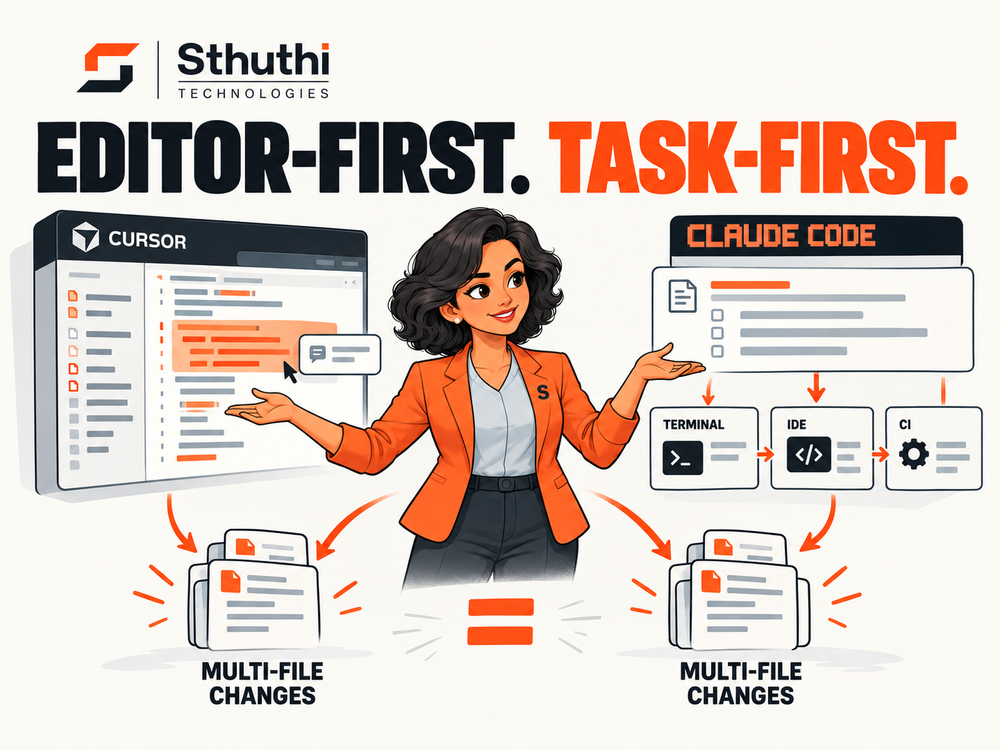
In Cursor, the starting point is the editor. According to Cursor's documentation, the agent is built into the code editor, with plan mode, code review and integrations for GitHub, GitLab, Azure DevOps, Bitbucket, JetBrains, Slack and Linear. An engineer asks for a change, watches it land in the files they have open, and accepts or adjusts it there. That keeps the human close to every step.
In Claude Code, the starting point is the task. According to Anthropic's overview, the same engine runs in the terminal, VS Code, JetBrains, a desktop app and the browser, and the same CLAUDE.md, settings and MCP servers follow it across all of them. It can also run without anyone watching: in GitHub Actions or GitLab CI/CD, on a schedule, or triggered from Slack. That suits teams that want to hand off whole tasks, such as test backfills, dependency updates or first-pass reviews, and come back to a pull request.
What changes for your reviewers
The tool you pick changes where review happens, and that matters more for a team than any feature list.
- With Cursor, much of the review happens as the change is made, by the engineer who asked for it. That's fast, but it means the quality of review depends on each engineer's habits. Two engineers can accept very different things.
- With Claude Code, more work arrives as a finished diff or pull request, especially when it runs in CI or in the background. Review moves to the pull request, where a second person often sees it. Diffs can be larger, so reviewers need a clear checklist for scope creep and new dependencies.
Either way, agree what "reviewed" means before rollout. Our review checklist for agent-written code works for both tools.
Governance: what each team plan gives you
For a team, the admin controls decide what's safe to roll out. From each vendor's pricing page:
- Cursor Teams includes centralised billing and administration, a team marketplace for internal rules, skills and plugins, cloud agents with shared team context, usage analytics, team-wide privacy mode and SAML/OIDC single sign-on. Cursor Enterprise adds pooled usage, SCIM, repository, model and MCP access controls, auto-run, browser and network controls, audit logs and an AI code tracking API.
- Claude Team includes Claude Code, single sign-on and domain verification, central billing, usage analytics, organisation-wide skills and organisation instructions. Claude Enterprise adds role-based access, SCIM, audit logs, a compliance API, custom data retention and spend limits. Claude Code also has managed settings that individual users can't override, and exports usage metrics through OpenTelemetry.
The pattern is the same on both sides: single sign-on and analytics on the team plan, audit logs and SCIM on enterprise. If your security team needs audit logs from day one, budget for the enterprise tier of either.

Seat cost for a team
List prices from Cursor and Claude, checked 9 October 2026:
| Plan | List price |
|---|---|
| Cursor Teams | $40 per user per month |
| Cursor Enterprise | Custom pricing |
| Claude Team, standard seat | $20 per month billed annually, or $25 monthly |
| Claude Team, premium seat (5x standard usage) | $100 per month billed annually, or $125 monthly |
| Claude Enterprise | $20 per seat per month billed annually, plus usage at API rates |
Seat prices are only half the bill. Both vendors meter heavy use, so the real cost depends on how much work your engineers hand to the agent. Run a pilot, read the usage dashboards, then budget. Our guide to measuring AI coding impact shows which numbers to track alongside cost.
When running both makes sense
Plenty of teams don't pick one. Anthropic publishes a Claude Code extension for Cursor, so an engineer can keep Cursor as their editor and run Claude Code inside it. If you go this way:
- Share one set of project instructions. Claude Code can read an existing AGENTS.md, so keep shared conventions there and mirror the essentials into your Cursor rules.
- Use one review standard for every agent-written diff, whichever tool produced it.
- Watch the double spend. Two subscriptions per engineer adds up. Check usage after a month and drop whichever one people aren't using.
Five questions to settle before you choose
- Where do your engineers spend the day: inside one editor, or across the terminal, CI and several IDEs?
- Do you want to switch between model providers, or have you standardised on Anthropic?
- Which controls does your security team need on day one: SSO only, or audit logs, SCIM and per-repository access?
- How much work will run unattended, in CI or on a schedule, rather than with an engineer watching?
- Who will review agent-written changes, and against what standard?
Weighing OpenAI's agent as well? See the three-way comparison: Claude Code vs Codex vs Cursor for teams.
Certify the judgment, whichever you pick
The skills that decide whether either tool helps are the same: framing a task clearly, reviewing what the agent changed, and knowing when to take over. We run a Cursor certification track and a Claude Code certification track, each ending in a proctored task inside the real tool, reviewed by a human assessor. We're independent of both vendors.
Sources: Cursor documentation; Cursor pricing; Claude Code overview; Claude pricing. Checked 9 October 2026.
Frequently asked questions
Is Cursor better than Claude Code for a team?
Neither is better for every team. Cursor suits teams that work inside one editor and want to switch between model providers. Claude Code suits teams that work across the terminal, several IDEs and CI and have standardised on Anthropic's models.
Can you use Claude Code inside Cursor?
Yes. Anthropic publishes a Claude Code extension for Cursor, so engineers can keep Cursor as their editor and run Claude Code inside it.
Which is cheaper for a team, Cursor or Claude Code?
At list price on 9 October 2026, Cursor Teams was $40 per user per month and a Claude Team standard seat was $20 per month billed annually or $25 monthly. Both meter heavy usage, so the real cost depends on how much work engineers hand to the agent.
Should my team use both Cursor and Claude Code?
It can make sense when different groups work differently. Keep one set of shared project instructions, one review standard for every agent-written diff, and check after a month whether both subscriptions are being used.
Want your team's AI-tool usage actually checked?
See the published certification tracks, or tell us about the tool you're worried about.