
Will Claude Code certification help the Class of 2027 get hired?
It can help a graduate get noticed, but mainly as evidence of work they can explain and defend. What the hiring and layoff data supports, what it doesn't, and how to use a credential well.
October 5, 2026 · 15 min read

The short answer
Yes, a Claude Code certification can help a student graduating in 2027 get noticed, but its strongest use is as evidence of work the student can explain and defend, not as a badge that guarantees an interview or protects a job. Sthuthi Technologies' proposed hands-on assessment fits that purpose better than a course-completion badge, although no published placement data establish how much its credential improves hiring outcomes. [1, 2]
- Conditional Hiring Advantage: NACE reports that AI skills appeared in 16.5% of entry-level job descriptions in its spring 2026 employer survey, up from 10.5% in the fall survey → show a working project and the decisions behind it alongside the credential. [3]
- Practical Assessment: Sthuthi says candidates complete a live repository task and explain their code review to a human assessor → its strongest claim is a test of judgment, not a promise of placement. [1]
- Credential Distinction: Anthropic's official Developer Foundations exam assigns 3.1% of its blueprint specifically to Claude Code, while Sthuthi focuses its assessment on using Claude Code in a repository → choose the credential that matches the work you want to show. [2, 4]
- Graduate Market: US employers surveyed by NACE projected 5.6% more hiring for the Class of 2026, while an Indian survey found 73% of employers intended to hire freshers in January-June 2026 → neither figure is a hiring forecast for the Class of 2027. [5, 6]
- Real Layoff Risk: US employers announced 573,195 planned job cuts through September 2026; AI was cited in 120,136 of those announcements → learning AI is sensible, but a certificate cannot insure anyone against restructuring. [7]
- AI Use And Layoffs: In Gallup's technology-industry comparison, workers using AI less than monthly were three times as likely to have been laid off as workers using it at least monthly → treat this as an association, not proof that using AI prevents a layoff. [8]
- Early-Career Pressure: Stanford finds a 19% relative employment gap for young workers in highly AI-exposed occupations, driven chiefly by reduced hiring rather than increased separations → build experience before graduation, particularly through projects and internships. [9]
- Evidence Gap: Neither of Sthuthi's pages supplies a graduate placement rate or a measured interview advantage for its credential → ask for employer-recognition and graduate-outcome evidence before paying for a place. [1, 2]
What Sthuthi's Claude Code track offers a 2027 graduate
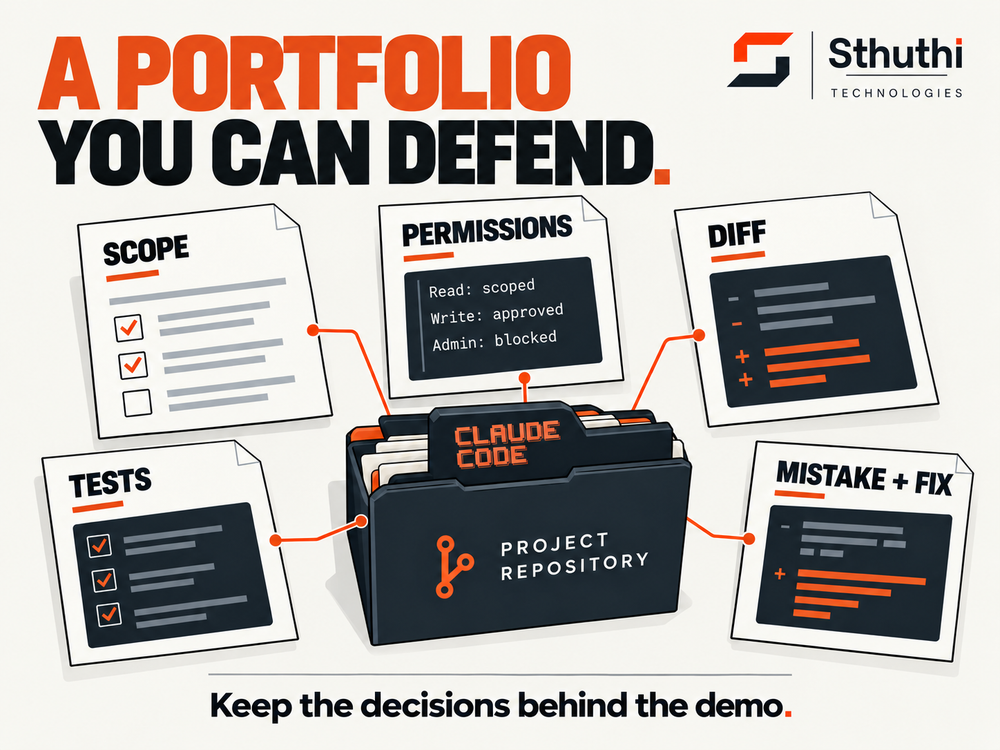
The Sthuthi Claude Code certification page describes an independent credential with Foundations, Practitioner and Expert levels, taught through a cohort plus asynchronous work. Its stated assessment is concrete: direct Claude Code through a scoped change in a live repository, then explain the resulting diff to an assessor before it merges. The review covers correctness, unwanted changes and permission boundaries. Sthuthi explicitly says Anthropic does not issue this credential. [1]
That design addresses a hiring manager's reasonable doubt about AI-assisted coding. A candidate can produce a working demo by accepting whatever an agent writes. Explaining why a change is safe, which files the agent could touch, what tests ran and where a person took over is a harder test. Sthuthi says a human assessor signs off on every attempt and that its credential has a verifiable ID. Those are the provider's descriptions of its process; they are not independent evidence that employers recognize the credential. [2, 10]
Sthuthi's accompanying article on Claude Code certification makes a useful distinction. Anthropic offers public training, including Claude Code courses, and it also has a separate, proctored certification program. Sthuthi presents its own assessment as a way for organizations outside that partner-gated exam process to test repository-specific judgment. Its Claude Code track is advertised to engineering teams; the page does not give a public price, an individual-student sign-up route or a placement rate. A student should establish whether individual enrollment is possible rather than assume that "open to any company" means open individual registration. [1, 2]
Consider a student asked to add lead classification to an existing application. The weak submission is a screenshot and a certificate. The stronger submission is a small change with a stated goal, permission limits, tests, an inspected diff and an explanation of any incorrect output that the student fixed. That is a proposed portfolio exercise, not a reported Sthuthi graduate outcome. It mirrors the task framing and human review the provider says it assesses. [1]
The decision is favorable to Sthuthi's assessment model, with a clear limit: a supervised repository task could give a 2027 graduate better material for an interview. The pages do not show that the credential alone raises callback rates.
Anthropic's official exam and Sthuthi's assessment test different things
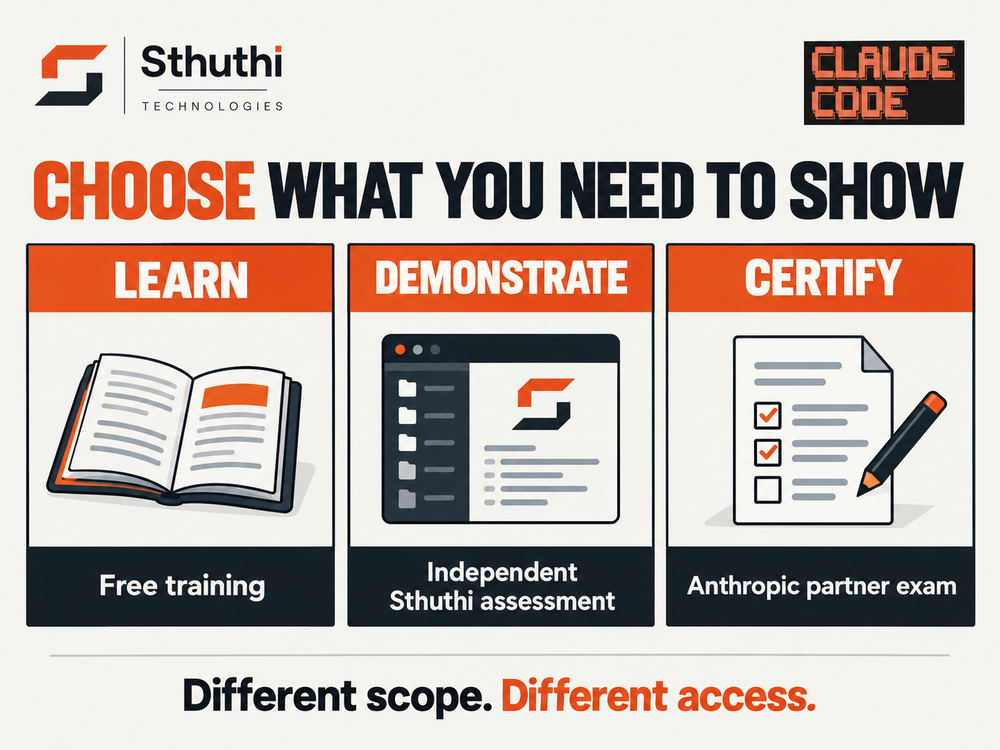
Anthropic now has an official certification program. Pearson VUE lists four credentials, including Claude Certified Developer - Foundations, or CCDV-F, and says certification is open to organizations in the Claude Partner Network. Anthropic describes its exams as supervised and identity-verified. A student must not label Sthuthi's independent award "Anthropic certified" on a resume. [1, 11, 12]
Anthropic's July 2026 CCDV-F exam guide lists multiple-choice or multiple-response items, a 120-minute limit and a $125 exam fee. It says recommended experience is not mandatory; registration runs through Anthropic Partner Academy and Pearson VUE. The dedicated Claude Code domain accounts for 3.1% of the exam blueprint. Applications and integration account for 33.1%, while agents and workflows account for 14.7%. This is a broader Claude development exam, not a stand-alone test of editing and reviewing code in a live repository. [4]
| Route | What a graduate can show | Access and limit |
|---|---|---|
| Anthropic's free Claude Code training | Completion of instruction on scoping, permissions and verification | The "Claude Code in Action" course advertises free registration; completing training is distinct from passing a supervised certification exam. [2, 13] |
| Sthuthi's Claude Code track | A provider-described, human-assessed repository task and independent credential | Geared toward team cohorts; public student enrollment, price and placement outcomes are not stated on the track page. [1] |
| Anthropic CCDV-F | An official, proctored exam across Claude development topics | Partner-network organizational access; $125 listed exam fee; 3.1% of its blueprint specifically concerns Claude Code. [4, 11] |
| Public project or internship | Code, tests, review history and an account of the student's own decisions | No certificate is needed, but the student must do and document the work. NACE says employers use skills-based screening in interviews and resume reviews. [14] |
The routes can work together. A student can learn from the free material, build a project and, if access and cost make sense, take an assessment. None should be described as equivalent to another.
Exam specifications, including the number of questions, can change between versions. Anthropic's official exam guide is the best source for the current format, so students should check it for the exam they actually plan to take. [2, 4]
The hiring market wants AI skills, but does it want this certificate?
The strongest available hiring figures measure demand for skills, not demand for Sthuthi's credential. NACE's 2026 spring employer survey found that 28.1% of responding employers sought candidates with AI skills and that AI skills appeared in 16.5% of entry-level job descriptions. Its sample comprised 185 employers surveyed between February 12 and March 17, 2026. In a separate NACE survey, almost two-thirds of responding employers said they used skills-based hiring; they reported using interviews, competency-based descriptions and resume scans for specific skills. [5, 14]
Other measures use different populations. Handshake found that 4.2% of its full-time postings mentioned AI as of March 2026, nearly twice the year-earlier share. Lightcast found that postings mentioning AI skills offered salaries 28% higher, or nearly $18,000 more a year, than postings without them in its analysis of over 1.3 billion postings. These numbers should not be averaged: one measures a share of listings on a platform, another reports employers' entry-level descriptions, and the pay comparison does not show that a certificate causes higher pay. [15, 16]
| Source and population | Finding | What a 2027 student can reasonably infer |
|---|---|---|
| NACE, US employer respondents | 16.5% of entry-level descriptions included AI skills; 28.1% of employers sought candidates who could use AI. [5] | Some employers will look for AI capability; the survey does not identify a preferred certificate. |
| Handshake, its full-time listings | 4.2% mentioned AI as of March 2026, nearly twice the prior-year share. [15] | Demand is rising on this platform, but most listings did not explicitly mention AI. |
| Lightcast, job-posting analysis | AI-skill listings advertised 28% higher salaries, nearly $18,000 more annually. [16] | This is a comparison of advertised jobs, not the earnings gain from taking a course. |
| TeamLease EdTech, Indian employers | 73% intended to hire freshers in January-June 2026; IT-sector hiring intent was 81%. [6] | Hiring intent is not the percentage of graduates who received offers. |
The Indian and US figures describe different markets and survey periods. Both support preparing for AI-assisted work; neither establishes a 2027 placement probability or a return on Sthuthi's fee.
A graduate also faces a second pressure: entry-level hiring can weaken even without mass layoffs. Stanford's updated analysis finds employment among 22- to 25-year-olds in highly AI-exposed occupations about 19% below where it would stand had it kept pace with similarly aged workers in less-exposed jobs. That is a relative employment gap, not a finding that 19% of young workers were laid off. Stanford says the change appears chiefly in reduced hiring and cautions that its descriptive data cannot assign all of the divergence to AI. Yale's Budget Lab, looking at broader US occupational and unemployment measures, reports no clear economy-wide AI labor-market footprint. A concentrated problem for young applicants and no clear broad displacement can both be true. [9, 17]
The practical decision is to target internships and entry-level roles with a portfolio that answers a specific engineering question. A general "AI certified" line cannot do that on its own.
What a student should be ready to defend in an interview
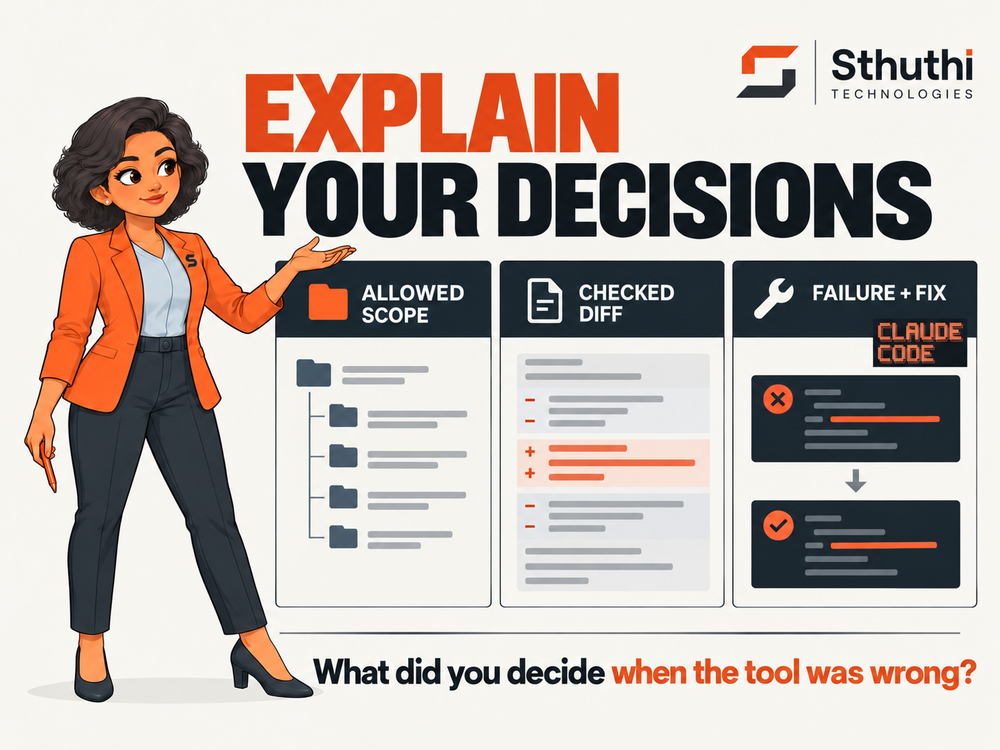
Claude Code can read files, make changes and run commands. Anthropic's own guidance recommends giving it checks that can pass or fail, such as tests, a build or a linter, and reviewing the result. It also describes permission controls and independent review of a diff. These are engineering controls, not prompt-writing tricks. [18]
Sthuthi's proposed live task turns those controls into questions a candidate must answer. What was the requested change? Which files and commands were allowed? Did the diff change anything outside scope? What failed in testing? What did the candidate, rather than the agent, decide? Its human assessor reviews the explanation before issuing the credential, according to the provider. [1]
One job advertisement in the material reviewed makes the distinction unusually plain. A Moscow employer seeking an "AI Vibe Coder" asked candidates to show one to three AI-assisted projects and described a short practical task involving a website, CRM and internal ERP. The employer wanted someone who could check and repair the output, not simply prompt a model. This is one employer's posting, for a middle-level role in Russia, not proof of a universal graduate hiring rule. [19]
A 2027 applicant could use the same test of competence in a modest portfolio project: connect a mock website form to a small API and database, classify requests with an AI service, and document what happens when the service fails. Keep a link to the code, tests and reviewable changes. In the interview, explain an error the tool made and the fix. Do not put invented savings, test counts or production usage on the resume.
A truthful resume line might read: "Built a [specific application] using Claude Code for a scoped change; reviewed its diff, added [actual number] tests and documented [specific failure and fix]. Sthuthi Technologies Claude Code certification, [level], [verification ID if issued]." This format makes the independent credential a pointer to inspectable work rather than an unsupported claim of Anthropic endorsement.
Layoffs: what the totals say and what they cannot say
The layoff concern is real. Challenger, Gray & Christmas reports that US employers announced 43,281 job cuts in September 2026 and 573,195 through the first nine months of the year. Technology companies announced 165,925 cuts year to date, about 29% of the total. Employers cited AI in 3,961 September cut announcements and 120,136 year-to-date announcements, about 9% and 21% respectively. These are announced plans and employers' stated reasons, not a verified count of workers dismissed because a model performed their tasks. [7]
Gallup answers a different part of the question. Its comparison finds that technology workers who used AI less than monthly were three times as likely to have been laid off as technology workers who used it at least monthly. Among laid-off respondents, 62% were AI non-users, compared with 50% of currently employed respondents; 22% of laid-off respondents and 28% of employed respondents were frequent AI users. Just 1% of laid-off workers identified AI as the primary reason for their layoff. Gallup does not publish, in this comparison, absolute layoff rates or numbers of laid-off workers divided into "AI-efficient" and "normal" groups. AI use is also not a measure of skill or certification. [8]
| Question | Best available finding | Limit |
|---|---|---|
| How many US cuts were announced through September 2026? | 573,195; AI was cited in 120,136. [7] | Announced cuts and stated reasons, not confirmed AI-caused dismissals. |
| Were AI users less likely to be laid off? | In Gallup's tech-worker comparison, using AI less than monthly was associated with three times the layoff likelihood of using it at least monthly. [8] | Relative association, not an absolute rate or causal effect. |
| How many certified AI-proficient workers were laid off versus other workers? | No defensible count or rate is established by these sources. | Neither dataset follows certificate holders into layoffs. [7, 8] |
Challenger counts what employers announce; Gallup asks workers about their experience. Their 21% and 1% AI-related figures have different populations and meanings, so neither cancels the other. Gallup also notes that job type, skill differences and other unmeasured factors could help explain its AI-use association. It would be misleading to turn "three times as likely" into a claim that a Claude Code certificate cuts an individual's layoff risk by two-thirds. [7, 8]
Block shows the hard side of the risk. In its fourth-quarter 2025 shareholder letter, the company said it was reducing a workforce of more than 10,000 to just under 6,000, affecting more than 4,000 people. It described the decision as a shift to smaller teams that could use AI tools to automate more work, while also reporting a strong 2025. The letter does not identify which departing employees used AI or held AI credentials. [20]
Amazon illustrates a different decision behind a large cut. Its announcement described an approximately 14,000-role reduction in its corporate workforce, framed around removing organizational layers and shifting resources. It also described AI as changing how fast companies can work, without publishing a worker-by-worker AI-skill comparison for those affected. Block's explicit smaller-team strategy and Amazon's organizational explanation warn against treating every layoff headline as the same event. Neither company supplies evidence that certified staff were immune. [21]
A 2027 plan that makes the credential useful
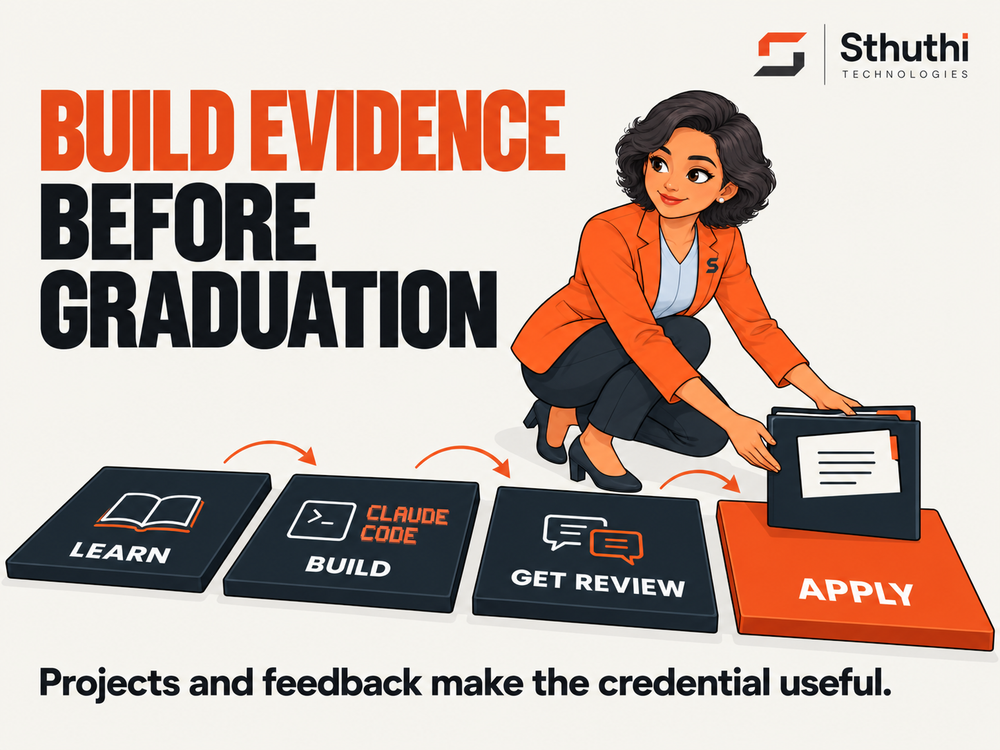
Start with the free training if access to the paid assessment is uncertain. Anthropic advertises free registration for its "Claude Code in Action" course, which covers scoping work, permission modes and verifying unattended runs. That offers a way to decide whether a Claude Code specialization suits the student's intended role before seeking a separate assessment. [2, 13]
Then produce evidence on a real or realistic codebase. Pick a contained change; record the starting issue, allowed file scope, checks run, final diff and a mistake caught during review. Repeat on another kind of task, such as an API change and a test or bug fix. If Sthuthi's cohort is accessible, its described live assessment offers a way to have that work questioned by a human reviewer. If it is not accessible to individuals, the portfolio still gives an interviewer something specific to examine. [1]
Apply for internships and work with other developers before graduation. NACE reports that nearly 60% of responding employers assign interns projects involving AI tools or skills. An internship can supply context a personal demo cannot: existing code, team review and responsibility for what ships. An applicant should state precisely what they built and checked, whether or not they later take a certification. [3, 14]
Before enrolling in Sthuthi's track, ask who can register, what it costs, what a failed attempt costs, how long verification lasts and whether the assessor provides feedback. Ask for employer-recognition or graduate-outcome data if placement value is the selling point. The published pages describe an assessment process, but do not provide the price or a measured hiring result. [1]
The decision rule is simple: choose the course for learning, the practical assessment for a defensible demonstration of repository work, and the official Anthropic exam if a relevant partner organization can give you access and you want its broader developer credential. Put whichever you earn beside projects and engineering fundamentals, not above them. [1, 2, 11]
The bottom line
Sthuthi, Anthropic and employers test different things. Sthuthi says it tests a candidate's decisions inside a live repository; Anthropic's CCDV-F tests a wider range of Claude development topics through a proctored exam; employers using skills-based hiring can still ask for work samples, interviews and evidence of sound judgment. Their scopes differ, their access differs, and none of the available evidence turns a credential into a quantified 2027 hiring advantage. [1, 4, 14]
The same distinction resolves the apparent layoff paradox. More employers are asking for AI skills, and Gallup observes lower layoff likelihood among more frequent AI users in technology. At the same time, Block says it can operate with a far smaller team using AI, while Stanford finds that young applicants in exposed roles are having a harder time entering employment. Employers can value AI capability and hire fewer people for some tasks. The available studies cannot tell us whether Sthuthi-certified graduates will be hired more often or laid off less often. [3, 8, 9, 20]
For a student graduating in 2027, our judgment is that Sthuthi's assessment is worth considering if it is accessible, reasonably priced and followed by a project the student can defend. Its emphasis on scoped changes, diff review and a human assessor gives the certificate a better story than mere course attendance. The claim stops there: placement gains and layoff protection have not been demonstrated by the cited pages or labor data. [1, 2]
Wondering what a course certificate is worth to recruiters? See what a Claude Code certificate proves (and what it can't). Running a college or placement cell? See the Claude Code programme for students. Want the team view of the same question? Read should companies certify their Claude Code teams, or see the Claude Code certification track.
Sources
- Claude Code Certification Training for Teams | Sthuthi Technologies
- Is there a Claude Code certification? Here's what actually exists | Sthuthi Technologies
- Ready or Reluctant? Employer Expectations for AI Skills Meet Student Skepticism (NACE)
- Claude Certified Developer – Foundations Exam Guide (Anthropic)
- 2026 Job Outlook spring update (NACE)
- TeamLease EdTech Career Outlook Report, January–June 2026
- September 2026 CHALLENGER REPORT
- Gallup: U.S. Workers Continue to Report Downsizing
- No Widespread Displacement, but the AI Employment Gap for Young Workers Has Widened to 19% - Stanford Digital Economy Lab
- About | Sthuthi Technologies
- Claude Certification Program | AI, Machine Learning & LLM Development
- Four role-based certifications for the people who put Claude to work for customers | Claude by Anthropic
- Claude Code in Action
- Almost Two-thirds of Employers Use Skills-based Hiring (NACE)
- Class of 2026 Graduation Report | Handshake
- New Lightcast Report: AI Skills Command 28% Salary Premium as Demand Shifts Beyond Tech Industry
- Tracking the Impact of AI on the Labor Market | The Budget Lab
- Best practices for Claude Code
- Job posting: AI Vibe Coder / Claude Code developer, Moscow (Habr Career, in Russian)
- Block Q4 2025 Shareholder Letter
- An update from SVP Beth Galetti on Amazon workforce reduction
Comparing student routes? See Claude Code courses for students, compared.
In India? See our page for Claude Code certification for engineering colleges.
Frequently asked questions
Is a Sthuthi Claude Code certification the same as an Anthropic certification?
No. Sthuthi's credential is independent and Anthropic does not issue it. Don't label it "Anthropic certified" on a resume.
Does a Claude Code certification guarantee a job or protect against layoffs?
No. No published placement data shows how much any Claude Code credential improves hiring outcomes, and no dataset follows certificate holders through layoffs. Treat it as one piece of evidence next to projects and fundamentals.
What should a graduate do before paying for an assessment?
Start with Anthropic's free Claude Code courses, build a contained project with tests and a reviewed diff, and ask the provider who can register, what it costs and what graduate-outcome evidence exists.
Want your team's AI-tool usage actually checked?
See the published certification tracks, or tell us about the tool you're worried about.